Research Article - Modern Phytomorphology ( 2026) Volume 20, Issue 1
Research on the ecologization of soil cultivation technologies on the level of weed infestation in sunflower, soybean and grain corn crops
Didur Ihor, Pantsyreva Hanna*, Polishchuk Mykhailo, Aralova Tetiana, Matusyak Mykhailo, Tsyhanska Olena, Palamarchuk Inna, Mostovenko Voldemar, Piddubna Antonina and Pankova SnizhanaPantsyreva Hanna, Vinnytsia National Agrarian University, Str. Sonyachna 3, 21002, Vinnytsia, Ukraine, Email: apantsyreva@ukr.net
Received: 21-Jan-2026, Manuscript No. mp-26-183001; Accepted: 18-Feb-2026, Pre QC No. mp-26-183001 (PQ); Editor assigned: 23-Jan-2026, Pre QC No. mp-26-183001 (PQ); Reviewed: 06-Feb-2026, QC No. mp-26-183001; Revised: 13-Feb-2026, Manuscript No. mp-26-183001 (R); Published: 20-Feb-2026, DOI: 10.5281/zenodo.19081177
Abstract
Modern biologized technologies require the implementation of scientifically sound measures that combine agrotechnical, chemical and biological methods, which makes this issue extremely relevant. The aim of the article was to evaluate the effectiveness of various forms of the drug Lipaktiv in combination with soil and insurance herbicides compared to the effect of Liposam on sunflower, soybean and corn crops for grain. Field and laboratory tests were conducted during 2021-2024 on the basis of the scientific research farm “Agronomichne” of the Vinnytsia National Agrarian University, located in the village of Agronomichne, Vinnytsia region. The main indicators were: The number of weeds and their death, according to standard methods. It was established that in experiments with sunflower, with natural moistening with an additional 100 mm of precipitation, 19 ± 4 weeds/m² were recorded on the control plot without the use of Liposam. The use of Liposam extra reduced this indicator to 12 ± 3 weeds/m², which is 7 units less. The best result was obtained when combining the soil herbicide with Liposam ultra 9 ± 1 weeds/m², which is 10 units less than the control. In the variant with the herbicide guardian tetra and Liposam, there was an average of 14 ± 3 weeds/m². On soybean crops, the combination of the herbicide with Liposam at doses of 0.5 and 0.8 l/ha turned out to be the best-the difference between these variants was insignificant. A similar picture was observed on corn crops. The results showed that the combination of the soil herbicide with the adhesive Liposam does not significantly affect the density of seedlings. The most effective 30 days after application was the use of Liposam ultra in combination with the herbicide, with a minimum level of weediness 9 ± 1 pcs/m². On soybeans and corn, the best results were also shown by the use of Liposam in doses of 0.5-0.8 l/ha. The minimum number of weeds on corn14 ± 3 pcs/m² was recorded in the variant with Liposam ultra 0.5 l/ha and additional moistening. The proposed agrotechnical approaches based on elements can be effectively implemented to improve the technologies for growing grain crops, in particular sunflower, soybeans and corn.
Keywords
Soybean, Sunflower, Corn, Environmental justification, Growth processes, Biologized technologies
Introduction
One of the key reasons for the decline in crop yields is excessive weed infestation (Kaletnik, et al. 2024, Didur, et al. 2024, Pantsyreva, et al. 2024, Kysylchuk, et al. 2024). This phenomenon is due to the large stock of weed seeds in the soil, which can remain viable for many years. A high concentration of weeds in crops creates significant difficulties for growing main crops, as weeds actively compete with them for moisture, nutrients and light, which significantly reduces the yield potential (Hetman, et al. 2025, Didur, et al. 2024). In this context, an important condition for effective farming is the quantitative assessment of changes in the level of weed infestation as an indicator of the effectiveness of the implemented technological solutions (Palamarchuk, et al. 2025, Okrushko, et al. 2025). Ignoring this factor can lead to an erroneous assessment of agricultural technologies, which, in turn, will cause crop losses and deterioration of the environmental situation (Didur, et al. 2025, Petrychenko, et al. 2024). That is why the development and implementation of scientifically based methods for controlling the number of weeds is of particular importance in the system of modern agriculture.
Given the economic feasibility and importance in the agricultural sector, the cultivation of strategically important crops, such as sunflower, soybean, and corn, is particularly relevant. Ensuring high yields of these market-forming crops requires an integrated approach to weed control, based on modern knowledge and technologies (Kaletnik, et al. 2025, Lys, et al. 2024, Sobko, et al. 2025, Zubov, et. al. 2025).
Materials and Methods
The purpose of the research is to study different groups of Lipaktiv on the effectiveness of soil and preventive herbicides in comparison with Liposam on sunflower, soybean and corn crops. Field studies were conducted during 2021-2024 at the experimental field of Vinnytsia National Agrarian University. The soil of the experimental field is grey forest medium loam. The predecessor was spring barley. The laying of field experiments was carried out according to generally accepted methods and state standards in crop production. The studies were accompanied by observations, records and relevant plant analyses. The total area of the plot is 15 m2, the placement of the plots is systematic in one tier (Tabs. 1-3).
| Control | Version 1 | Version 2 | Version 3 |
|---|---|---|---|
| Without adhesive | Liposam extra | Liposam ultra | Liposam |
Note: Natural moisture+100 mm; Adherent dose 0.5 l/ha
Table 1. Experimental design-study of the effect of different types of Liposam on the effectiveness of the soil herbicide guardian tetra on sunflower crops.
| Control | Version 1 | Version 2 | Version 3 |
|---|---|---|---|
| Without adhesive | 0,3 l/ha | 0,5 l/ha | 0,8 l/ha |
Table 2. Experimental design-study of the effect of different types of Liposam on the effectiveness of the soil herbicide guardian tetra on sunflower crops.
| Control | Control 2 | Version 1 | Version 2 |
|---|---|---|---|
| Natural humidity | Natural humidity+100 mm | Natural humidity | Natural humidity+100 mm |
Table 3. Experimental design-study of the degree of wetting on the effectiveness of the soil herbicide guardian tetra in a mixture with Liposam ultra on corn crops for grain.
Immediately after sowing, the soil herbicide gezagard (active ingredient-promethrin, 500 g/l) was applied to the soybean plots at a rate of 3 l/ha. The herbicide guardian tetra (active ingredients: acetochlor-450 g/l, terbuthylazine-214 g/l, furilazole-15 g/l) was applied to the corn plots at a dose of 3.5 l/ha, and the same drug was used on sunflower plots at a rate of 3.0 l/ha. Simultaneously with the herbicides, the biological adhesive Liposam was applied at dosages according to the experimental scheme.
The assessment of weather conditions during the research period was carried out based on data from the Vinnytsia Regional Center for Hydrometeorology. During 2021-2024, climatic conditions were difficult for the growth and development of soybeans, corn, and sunflower. In some periods, significant deviations from the long-term averages were observed. Precipitation was uneven, the growing season was characterized by long droughts. The value of the Hydrothermal Coefficient (HTC) from the end of April to September was less than 1, which indicates a moisture deficit. This, in turn, had a negative impact on both the emergence of seedlings and the growth of weeds in sunflower crops, as well as on the effectiveness of soil herbicides and the biological adhesive Liposam.
Results and Discussion
During the years of research, under such conditions of natural moisture, a short-term type of weed infestation was formed in the experiment and consisted mainly of wintering weeds, and only a small proportion of spring and rhizomatous weeds. The species composition of weeds was as follows: Amaranthus retroflexus L., Convolvulus arvensis L., Agropyrum repens L., Cirsium arvense L., Setariaviridis, Setariaglauca, Chenopodium album L., Portulaca oleracea L.), Sonchus arvensis L.
Based on the conducted studies, it was found that the combination of soil herbicide with Liposam in various combinations did not have a significant effect on the density of seedlings. Based on the conducted observations and records, it was found that in the experiment with sunflower, the number of weeds in the control variant (without Liposam) with natural moisture of +100 mm was 19 ± 4 pcs/m2, and in the variants where Liposam extra was used, the number of weeds was on average 12 ± 3 pcs/m2, which is 7 pcs/m2 less than the control. The most effective 30 days after application was the combination of soil herbicide with Liposam ultra, while in these areas the number of weeds was 9 ± 1 pcs/m2, which is 10 pcs/m2 less than the control. When used with the soil herbicide guardian tetra, Liposam was formed on the experimental site on average 14 ± 3 pcs/m2 (Tab. 4).
| Experiment option | 30 days after application | At the end of the growing season | ||||||
|---|---|---|---|---|---|---|---|---|
| I | II | III | Average | I | II | III | Average | |
| Control | 20 | 26 | 24 | 23 ± 2,5 | 34 | 28 | 31 | 31 ± 2,4 |
| 0,3 l/ha | 24 | 18 | 22 | 21 ± 2,5 | 30 | 27 | 34 | 30 ± 2,9 |
| 0,5 l/ha | 18 | 15 | 16 | 16 ± 1,2 | 29 | 25 | 23 | 26 ± 2,5 |
| 0,8 l/ha | 17 | 13 | 14 | 15 ± 1,7 | 30 | 23 | 27 | 27 ± 2,9 |
| LSD0,5 | 4,7 | 4,6 | ||||||
Note: LSD: Least Significant Difference
Table 4. The effect of different types of Liposam when used together with the soil herbicide Guardian Tetra on the number of weeds in sunflower crops (natural moisture+100 mm).
The smallest significant difference in the experiment when recording 30 days after applying the herbicide was 4.2 pcs/m2, which indicates the reliability of the results obtained, while on the basis of the analysis of variance it was established that the studied factors influenced the reduction in the number of weeds by 68% and 32% was influenced by other unaccounted factors (Fig. 1).
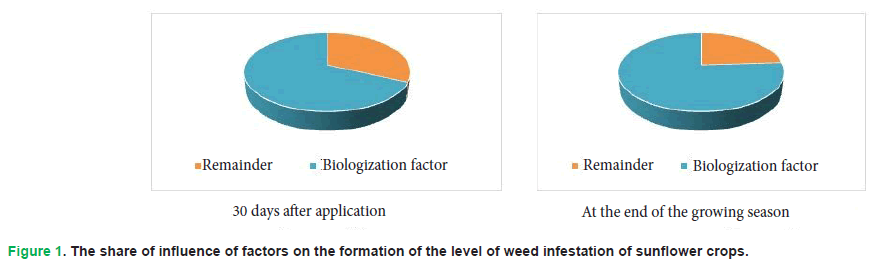
Figure 1: The share of influence of factors on the formation of the level of weed infestation of sunflower crops.
The minimum amount of precipitation during the growth and development of plants leveled the further influence of the studied factors on the growth and development of the weed group in the agrophytocenosis. Thus, based on the accounting at the end of the growing season, it was established that the proportion of weeds increased slightly, but the effectiveness of the use of Liposam significantly decreased and was within the error range.
Based on the observations and accounting, it was established that the number of weeds in soybean crops in the control variant (without adhesive) with natural moisture of +100 mm 30 days after application was 23 ± 2.5 pcs/m2, in the experimental variant, where Liposam was applied together with the soil herbicide at a dose of 0.3 l/ha, the number of weeds was on average 21 ± 2.5 pcs/m2 across the repetitions, which is 2 pcs. less than the control and is insignificant with the smallest significant difference of the experiment 4.7. When used together with the herbicide gezagard Liposam at a dose of 0.5 and 0.8 l/ha, the number of weeds significantly decreased and amounted to 16 ± 1.2 and 15 ± 1.7 pcs/m2, respectively (Tab. 5).
| Experiment option | 30 days after application | At the end of the growing season | ||||||
|---|---|---|---|---|---|---|---|---|
| I | II | III | Average | I | II | III | Average | |
| Control | 20 | 26 | 24 | 23 ± 2,5 | 34 | 28 | 31 | 31 ± 2,4 |
| 0,3 l/ha | 24 | 18 | 22 | 21 ± 2,5 | 30 | 27 | 34 | 30 ± 2,9 |
| 0,5 l/ha | 18 | 15 | 16 | 16 ± 1,2 | 29 | 25 | 23 | 26 ± 2,5 |
| 0,8 l/ha | 17 | 13 | 14 | 15 ± 1,7 | 30 | 23 | 27 | 27 ± 2,9 |
| LSD0,5 | 4,7 | 4,6 | ||||||
Note: LSD: Least Significant Difference
Table 5. Effect of different doses of Liposam when used together with the soil herbicide gezagard on the number of weeds in soybean crops (natural moisture+100 mm).
The most effective under these conditions when recording was the combination of soil herbicide with Liposam adhesive at a dose of 0.5 l/ha and 0.8 l/ha, while the difference between these options was minimal (Fig. 2).
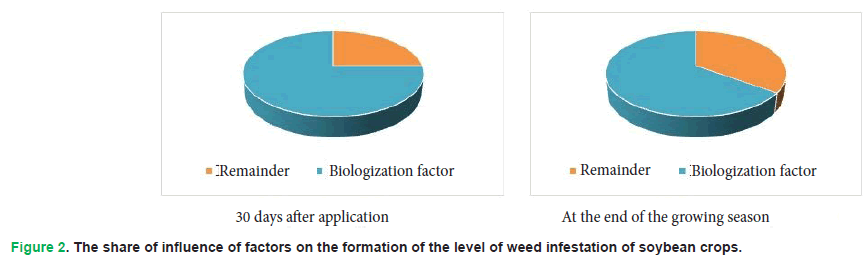
Figure 2: The share of influence of factors on the formation of the level of weed infestation of soybean crops.
When determining the effect of the degree of moisture on the effectiveness of the soil herbicide guardian tetra in a mixture with Liposam ultra on corn crops for grain, it was found that in the variants without the use of Liposam under natural moisture 30 days after applying the herbicide, the number of weeds was on average 19 ± 3 pcs/m2. In the variant with additional moisture (+100 mm), without the use of Liposam, the number of weeds was higher by an average of 7 pcs/m2 and was 26 ± 5 pcs/m2.
In the variants of the experiment, where together with the soil herbicide Liposam ultra was applied at a dose of 0.5 l/ha under natural moisture per 1 m2, an average of 17±2 pcs. weeds were formed, which is insignificant and only 2 pcs. less than without the use of Liposam ultra (Tab. 6).
| Experiment option | 30 days after application | At the end of the growing season | |||||||
|---|---|---|---|---|---|---|---|---|---|
| I | II | III | Average | I | II | III | Average | ||
| Control | Natural hydration | 22 | 17 | 19 | 19 ± 3 | 37 | 28 | 34 | 33 ± 5 |
| Natural hydration+100 mm | 28 | 24 | 27 | 26 ± 5 | 32 | 39 | 34 | 35 ± 3 | |
| Liposam | Natural hydration | 17 | 20 | 15 | 17 ± 2 | 26 | 34 | 28 | 29 ± 6 |
| Natural hydration+100 mm | 15 | 11 | 17 | 14 ± 3 | 24 | 20 | 26 | 24 ± 4 | |
| LSD0,5 | 4,4 | 7,3 | |||||||
Note: LSD: Least Significant Difference
Table 6. The effect of the degree of moisture on the effectiveness of the soil herbicide guardian tetra in a mixture with Liposam ultra in corn crops for grain.
The smallest number of weeds 30 days after application was recorded in the experiment variant using Liposam ultra 0.5 l/ha with additional moistening (+100 mm) and amounted to an average of 14 ± 3 pcs/m2. It was found that the difference between the variants with natural and additional moistening (+100 mm) with the application of Liposam ultra (0.5 l/ha) was insignificant and amounted to 3 pcs/m2.
At the end of the growing season, according to the results of the surveys, the influence of the studied factors on the number of weeds in crops was not detected.
Conclusion
According to the results of the studies conducted in the natural and climatic conditions of the Right-Bank Forest-Steppe, it was established that the combined use of soil herbicide with the adhesive Liposam in different variants did not have a significant impact on the density of seedlings of the studied crops. The highest efficiency 30 days after application was demonstrated by the combination of the herbicide with Liposam ultra in the corresponding areas the number of weeds was 9 ± 1 pcs/m², which is 10 units less compared to the control option. In soybean crops, the most effective was the use of soil herbicide in combination with Liposam in doses of 0.5 and 0.8 l/ha; the difference between the options was insignificant. In the case of corn, the minimum number of weeds (14 ± 3 pcs/m²) 30 days after treatment was recorded in areas where Liposam ultra was used in a dose of 0.5 l/ha with additional moistening (+100 mm). The results obtained indicate the feasibility of using such technological solutions to optimize the system of growing sunflower, soybeans, and corn for grain, which will contribute to increasing the efficiency of weed control and improving the overall productivity of agrocenoses.
References
- Didur I, Pantsyreva H. (2025). Prospects for the development of seed production in Ukraine taking into account economic and environmental efficiency. Balt J Econ Stud. 11:191-196.
- Didur I, Vdovenko S, Tkachuk O, Palamarchuk I, Pantsyreva H, Chabaniuk Y, Shkatula Y, Zabarna T, Gucol G. (2024). Cultivation of tomatoes using mycorrhizal biological preparations. Mod Phytomorphol. 18:133-138.
- Didur I, Pantsyreva H, Kupchuk Ð, Volynets Y. (2024). Formation of yield and quality of chickpea seed products under climate change. Mod Phytomorphol. 18:170-173.
- Hetman N, Karbivska U, Hryhoriv Y, Degtyarjov V, Marenych M, Malynka L, Kurhak V, Golodna A, Veklenko Y, Gniezdilova V. (2025). The influence of fertilisation systems on the productivity and quality of different varieties of alfalfa (Medicago sativa L.). J Ecol Eng. 26:220-227.
- Kaletnik H, Yaropud V, Lutkovska S, Aliiev E. (2024). Studying the air flow heating process in the vertical type ground heat exchanger. Przeglad Elektrotechniczny. 100:46-54.
- Kaletnik G, Sakhno A, Pryshliak N, Lutkovska S, Kolomhets T. (2025). Economic evaluation of environmental protection activities in the context of sustainable development: The experience of Ukraine. Polityka Energ Policy J. 28:217-236.
- Kysylchuk A, Zakharchenko E, Rudska N, Bolshakov Y, Kriuchko L, Berdin S, Hlupak Z, Burko L, Tkachenko R, Hnitetskyi M, Zubko O. (2024). The share of sunflower in the structure of cultivated areas of Ukraine in pre-war and wartime. Mod Phytomorphol. 18:18-22.
- Lys N, Kolisnyk O, Klymchuk O, Verheles P, Tkachuk N, Sakhoshko M, Rozhko V, Karpenko O, Kriuchko L, Bordun R, Vandyk M. (2024). Economic and energy assessment of willow and poplar cultivation depending on the density of the plantation and the nutritional background. Mod Phytomorphol. 18:130-137.
- Okrushko SE, Verheles PN, Aralova TS. (2025). Effect of Ascochyta rabiei on symbiotic efficiency and productivity of Cicer arietinum. Regul Mech Biosyst. 16:e25001.
- Palamarchuk V, Lohosha R, Skakun M. (2025). Economic efficiency of maize cultivation using digestate in Ukraine. Balt J Econ Stud. 11:357-366.
- Petrychenko V, Korniychuk O, Lykhochvor V, Kobak S, Pantsyrev O. (2024). Study of sowing quality of soybean seeds depending on pre-sowing treatment of seed. J Ecol Eng. 25:332-339.
- Pantsyreva H. (2024). Economic aspects of organic soy production in Ukraine. Balt J Econ Stud. 10:324-331.
- Sobko M, Zakharchenko E, Kolisnyk O, Medvid S, Kysylchuk A, Krokhin S, Rudska N, Amons S, Omelianenko O, Bondarets R, Surzhykov M. (2024). Yield and energy efficiency of sunflower cultivation under different primary soil tillage methods. Modern Phytomorphol. 18:200-204.
- Zubov A, Zubova L, Zubov A, Demyanyuk O, Mudrak H. (2024). Assessment of the state of forest vegetation of waste dumps of coal mines in Ukraine. Biosystems Diversity. 3:345-357.