Research Article - Modern Phytomorphology ( 2026) Volume 20, Issue 4
Winter wheat productivity and profitability depending on water supply in the semi-arid agroecological conditions
Dmytro Maksymov1, Pavlo Lykhovyd2*, Viktor Chaban3, Oleksandr Rudik1,4, Gennadiy Karashcuk5, Mykhailo Retman2, Iryna Biliaieva6, Oleksandr Kazanok5, Mykhailo Kliuchevych7, Larysa Kucher8, Ihor Kovalenko2 and Valerii Kozyriev12Institute of Water Problems and Land Reclamation of NAAS, 03022 Kyiv, Ukraine
3Kherson State Maritime Academy, 73000 Kherson, Ukraine
4Odesa State Agrarian University, 65012 Odesa, Ukraine
5Kherson State Agrarian and Economic University, 25031 Kropyvnytskyi, Ukraine
6Luhansk Taras Shevchenko National University, 37500 Lubny, Ukraine
7State University of Zhytomyr Polytechnic, 10005 Zhytomyr, Ukraine
8National University of Life and Environmental Sciences of Ukraine, 03041 Kyiv, Ukraine
Pavlo Lykhovyd, Institute of Water Problems and Land Reclamation of NAAS, 03022 Kyiv, Ukraine, Email: likhovid@gmail.com
Received: 14-Aug-2026, Manuscript No. mp-26-193676; Accepted: 15-Oct-2026, Pre QC No. mp-26-193676 (PQ); Editor assigned: 17-Aug-2026, Pre QC No. mp-26-193676 (PQ); Reviewed: 21-Sep-2026, QC No. mp-26-193676; Revised: 12-Oct-2026, Manuscript No. mp-26-193676 (R); Published: 23-Oct-2026 , DOI: 10.5281/zenodo.23753536
Abstract
Climate variability in semi-arid environments necessitates a comprehensive evaluation of agricultural inputs relative to yield and resource efficiency. A two-year field experiment was conducted in southern Ukraine to evaluate the performance of winter wheat (Triticum aestivum L., cv. Mudrist) under irrigated and rainfed conditions following a pea predecessor. Irrigation significantly increased plant height by an average of 10.25 cm and grain yield by 26.3% compared to the rainfed control. Thousand-kernel weight and yield stability also improved under irrigation. Furthermore, irrigation enhanced total water resource utilization, reducing Water Use Efficiency (WUE) values from 81.54 mm/t in the rainfed treatment to 77.13 mm/t under irrigation. From an economic perspective, irrigation produced an additional net profit of 77.24 USD/ha. However, due to a 26.4% increase in production costs, the Return On Investment (ROI) did not differ significantly between treatments. These findings demonstrate that while irrigation delivers clear agronomic and resource efficiency benefits essential for food security, its financial profitability is highly sensitive to seasonal precipitation. Dynamic supplemental irrigation management based on seasonal moisture forecasting is recommended to optimize both water use efficiency and economic returns. The developed multiple linear regression model allowed precise winter wheat yield prediction using the 1000-kernel weight and plant height at the earing phase with the R2 score of 0.807 and mean absolute error of 0.209 t/ha.
Keywords
Agricultural water management, Food security, Irrigation, Moisture deficit, Return of investment, Yield prediction
Introduction
In semi-arid and arid climates, irrigation is the main driving force of sustainable crop production because of severe natural moisture supply deficits. Moisture availability has recently become one of the strongest limiting factors for crop production in vulnerable regions of the planet. The tendency toward water-deficit-related yield losses is aggravated by a gradual increase in air temperature accompanied by increasing evapotranspiration rates, frequent extreme heatwaves and drought events, a lack of rainfall in the warmperiod of the year, as well as its uneven spatiotemporal distribution, and global freshwater scarcity. Modern agriculture is the biggest water consumer, accounting for 70% of global freshwater consumption, and as climate change continues, this percentage is projected to increase further (Pomoni, et al. 2023). Therefore, on the one hand, there is no alternative for food security other than to artificially provide moisture supply through irrigation systems. On the other hand, there is an urgent need to save as much freshwater as possible. To solve this dilemma, it is necessary to investigate the real-life impacts of irrigation on crop productivity in different semi-arid and arid environments across the planet and determine whether it is rational to use irrigation for crop cultivation in every particular set of agroecological, technological, and economic conditions (Hashemi, et al. 2024).
Crop production in the south of Ukraine is especially vulnerable to global-warming-related challenges. Being naturally dry, this region is gradually transforming into a zone where sustainable, economically viable production of major staple crops, including wheat, soybeans, and grain corn, is becoming almost impossible under rainfed conditions. Most of the zone is characterized as semi-arid with a tendency toward a gradual shift to an arid climate zone according to the United Nations Environment Programme (UNEP) aridity index values, which fluctuated within the range of 0.30-0.48 for the period 2010-2020 (Lykhovyd, 2021). Therefore, this is a zone of risky agriculture, and irrigation is mandatory to guarantee crop production and ensure food security in the region.
Today, irrigation is among the most impactful factors influencing crop productivity. Some national researchers refer to irrigation as the main guarantee of food security in Ukraine in the context of rapid climate change and its associated challenges regarding natural moisture deficits (Vozhegova and Kokovikhin, 2018). Markova, et al. 2025 established that the irrigated cultivation of sunflower, winter wheat, and rapeseed resulted in significant yield gains of 28-48%, 15-25%, and 25-35%, respectively. In addition to direct quantitative yield gains, irrigation led to a significant improvement in crop quality. A prominent increase (2.6 times on average) in winter wheat yield as a result of irrigation was also reported by Lavrynenko, et al. 2019.
Although the positive effects of irrigation on crop productivity are undoubted, it is questionable whether these yield gains cover the expenses of artificial water supply. In the context of freshwater scarcity, the consequent increase in prices for irrigation water, and growing expenses for the maintenance and reconstruction of irrigation systems, it is necessary to investigate not only the yield outcomes but also the economic returns of irrigation. It should be noted that the latter may vary greatly depending on the crop and irrigation system, with generally higher payback observed in drip irrigation systems, and much lower returns in overhead and furrow irrigation (Markova, et al. 2025). Also, the cost of water supply must be taken into account (Romashchenko, et al. 2021).
Therefore, the main goal of this study is to provide a scientific substantiation of the advantages of irrigated winter wheat cultivation compared to rainfed methods in the semi-arid climate of the south of Ukraine, considering both the yield and economic benefits of artificial moisture supply.
Materials and Methods
The experimental part of the study was conducted during the 2025-2026 growing season in the fields of the private agricultural farm “Vostok,” located in the Bilozerka district of the Kherson region, southern Ukraine. The soil of the experimental plots is a dark-chestnut, slightly saline soil with an average 0-20 cm layer content of: ammonium nitrogen-7.23 mg/kg (low supply); nitrate nitrogen-7.06 mg/kg (moderate supply); mobile phosphorus-38.95 mg/kg (high supply); and exchangeable potassium-236.67 mg/kg (high supply). The content of total soluble salts in the 0-20 cm layer was 0.117%, which is classified as slightly saline soil. In general, these soil properties were favorable for winter wheat cultivation.
Climatically, the trial site lies within the semi-arid steppe zone of Ukraine, which is characterized by abundant heat resources, dry weather, and unstable moisture supply throughout the growing season (Lykhovyd, et al. 2025). Meteorological data for the winter wheat growing season are presented in Tab. 1. The largest difference in average monthly air temperature was observed during early winter wheat growth and development. During the rest of the growing season, temperature differences were minimal. Regarding rainfall amounts, the study period was much wetter than the long-term average.
| Month | Average air temperature (°C) | Rainfall (mm) |
|---|---|---|
| October | 11.3 (+0.7) | 59.4 (+29.8) |
| November | 9.8 (+5.4) | 39.5 (+9.1) |
| December | 2.4 (+2.4) | 25.0 (-3.8) |
| January | -2.2 (-0.3) | 54.3 (+26.9) |
| February | -1.4 (-0.2) | 33.8 (+10.3) |
| March | 7.1 (+3.9) | 9.5 (-14.9) |
| April | 9.2 (-1.1) | 33.3 (+6.7) |
| May | 15.4 (-0.7) | 65.7 (+29.4) |
| June | 21.2 (+0.8) | 39.1 (-4.7) |
Table 1. Meteorological characteristics of winter wheat growing season compared to long-term norm (± difference).
The experiment was conducted in four replications using a standard randomized block design. The trial evaluated a single factor with two variants: Irrigated and non-irrigated (rainfed).
Winter wheat (Triticum aestivum L., cv. Mudrist) was used as the plant material. The crop was sown following a pea predecessor (Pisum sativum L.). After weed-provoking rainfall, the systemic herbicide Roundup Max (potassium salt of glyphosate, 450 g/L) was applied at a rate of 3.0 L/ha. Primary tillage consisted of shallow plowing, followed by pre-sowing seedbed cultivation to a depth of 3-5 cm. Prior to sowing, winter wheat seeds were treated with the fungicide Kinto Duo (prochloraz, 60 g/L+triticonazole, 20 g/L) at a rate of 2.0 L/t and the insecticide Gaucho (imidacloprid, 600 g/L) at a rate of 0.5 L/t, supplemented with the growth stimulant Raykat Start (nitrogen-4%, phosphorus-8%, potassium-3%, polysaccharides-15%, free amino acids-4%, phytohormones-0.05%) at a rate of 1.0 L/t. Sowing was carried out to a depth of 3-4 cm with an inter-row spacing of 19 cm at a seeding rate of 4 million viable seeds/ha. In spring, following the resumption of vegetative growth and the establishment of optimal temperatures, crops were treated with the herbicide Pallas Extra (pyroxsulam, 250 g/kg+halauxifen-methyl, 66.67 g/kg+cloquintocet-acid, 354 g/kg) at a rate of 0.09 kg/ha. At the flag leaf stage (BBCH 39), the fungicide Rex Duo (epoxiconazole, 187 g/L+thiophanate-methyl, 310 g/L) was applied to protect the wheat against fungal diseases. Harvesting was performed at the full maturity stage (BBCH 89). At the heading stage, plant height was measured. Grain yield was adjusted to a standard 14% moisture content and 100% purity. The 1000-Kernel Weight (TKW) was also determined. In the irrigated variant, in addition to the described agrotechnological operations, two overhead sprinkler irrigations at a rate of 35 mm each were performed during the pre-tillage and pre-sowing periods.
Initial data processing with average values and Standard Deviation calculations (SD) was performed using Microsoft Excel. Statistical analysis, including one-way Analysis Of Variance (ANOVA) followed by Tukey-Kramer’s Honestly Significant Difference (HSD) post-hoc test, was conducted using a custom C++ script at p<0.05 (Hilton and Armstrong, 2006). The Pearson’s pairwise correlation analysis and matrix creation were performed in Python 3 using Pandas, Matplotlib and Seaborn external libraries (Taylor and Bates, 2013). Mathematical modeling of winter wheat yield was performed by the algorithm of Ordinary Least Squares (OLS) multiple linear regression with regression 3D scatter plot and plane in Python 3 using Scikit-learn external library (Mahaboob, et al. 2018). The recompensation of irrigation water was calculated as a difference between the irrigation-related expenses and the value of the additional grain, harvested from the irrigated plots. The estimation was performed using the prices of 2026. The price for wheat grain was 174 USD/t. The cost of irrigation water supply to the experimental fields was 1.78 USD/mm.
Results and Discussion
The statistical evaluation revealed significant differences in the evaluated parameters of winter wheat depending on the moisture supply regime. First, plant height was significantly greater under irrigation-exceeding the rainfed control by an average of 10.25 cm. Second, significantly higher yields were harvested from the irrigated plots, with the average grain productivity difference reaching 26.3%. A similar trend was observed for 1000-Kernel Weight (TKW) in favor of the irrigated treatment. In addition, irrigation resulted in higher yield stability across replicates, as reflected by lower Standard Deviation (SD) values for both yield and TKW (Tab. 2).
| Parameter | Irrigated | Non-irrigated |
|---|---|---|
| Plant height (cm) | 70.50 ± 5.45 | 60.25 ± 4.57 |
| Grain yield (t/ha) | 5.57 ± 0.08 | 4.41 ± 0.30 |
| 1000-kernel weight (TKW, g) | 52.05 ± 1.08 | 45.78 ± 1.16 |
*Notes: HSD05: Plant height-8.70 cm; grain yield-0.38 t/ha; TKW-1.94 g.
Table 2. Winter wheat productivity parameters depending on moisture supply ± SD*.
The studied productivity traits significantly correlated with each other. The correlation matrix (Fig. 1a) points out that the strongest relationship is established for TKW-grain yield pair, while the influence of plant height on the crop productivity is less prominent. The autocorrelation between the TKW and plant height is moderate, with low risk of multicollinearity in the multiple regression model. The grain yield prediction using plant height and TKW inputs is reasonable, with the R2 score of 0.807 and mean absolute error of the model 0.209 t/ha (or 4.19%). The regression plane in 3D scatter plot is presented in Fig. 1b. The model’s equation is as follows: y=0.0319 PH+0.1156 TKW, where y is grain yield of winter wheat, t/ha; PH is Plant Height in the earing phase, cm; TKW is 1000-kernel weight, g.
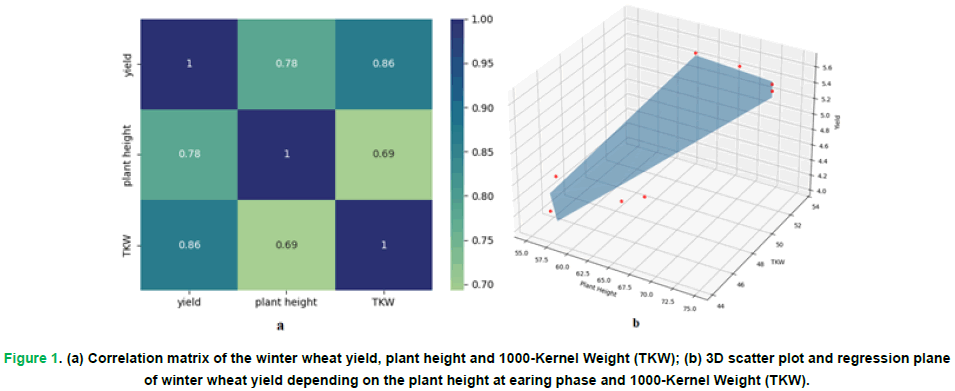
Figure 1: (a) Correlation matrix of the winter wheat yield, plant height and 1000-Kernel Weight (TKW); (b) 3D scatter plot and regression plane of winter wheat yield depending on the plant height at earing phase and 1000-Kernel Weight (TKW).
Regarding the economic return of irrigation, the irrigated treatment generated an additional net profit of 77.24 USD/ha (Tab. 2). However, it should be taken into consideration that irrigation management required additional 124.60 USD/ha expenses for crop production.
At first glance, irrigation suggests an undebatable economic benefit. However, a deeper analysis of other key indicators-specifically Return On Investment (ROI, %)-demonstrates no significant difference between irrigated and rainfed crop production, despite the higher net profit of the former (Tab. 3).
| Indicator | Value |
|---|---|
| Yield gain (t/ha) | 1.16 |
| Price of additional yield (USD/ha) | 201.84 |
| Irrigation expenses (USD/ha) | 124.60 |
| Pure profit from irrigation (USD/ha) | 77.24 |
Table 3. The pure profit from irrigation application on winter wheat.
| Indicator | Irrigated | Non-irrigated |
|---|---|---|
| Production expenses (USD/ha) | 597.6 | 473.0 |
| Gross value (USD/ha) | 969.2 | 767.3 |
| Net profit (USD/ha) | 371.6 | 294.3 |
| Return of input (%) | 62.18 | 62.22 |
Table 4. The Return Of Input (ROI) of winter wheat cultivation depending on moisture supply.
Additional expenses, connected with irrigation and higher costs of harvesting and post-harvesting processing of grain from the irrigated plots, resulted in zero ROI increase. Given these results, justifying the implementation of full irrigation for winter wheat in the semi-arid conditions of southern Ukraine remains complex. From a food security perspective, our findings confirm that irrigation provides unambiguous benefits through higher grain output and improved quality. This aligns with recent findings by Ishaque, et al. 2023, who projected that climate change in the near future could reduce irrigated wheat productivity by 2-19%, compared to a sharper 9-30% decline in rainfed systems. However, from an ROI perspective, the 26.4% higher initial capital input required for irrigation technology does not yield a proportionally higher profitability rate. This outcome likely stems from the relatively high natural precipitation recorded during the study period; under such conditions, supplemental irrigation has been shown to offer minimal or even reduced profitability compared to rainfed cultivation (Oweis and Hachum, 2009). Therefore, decisions regarding irrigated winter wheat production in the semi-arid zone of southern Ukraine should carefully balance technical and economic trade-offs against short and long-term weather forecasts.
In addition, Water Use Efficiency (WUE) must be taken into account. In rainfed crop production, winter wheat relies primarily on natural precipitation, resulting in an average WUE of 81.54 mm/t. Under irrigation, WUE improved to 77.13 mm/t. Thus, irrigation significantly enhanced the overall efficiency of water resource utilization-combining both natural rainfall and applied irrigation water. Therefore, from the ecological point of view, irrigation could be claimed to be favorable for better agricultural water management in the semi-arid climate. This point finds support in the study by Oweis, et al. 2000, who reported that supplemental irrigation increased WUE of wheat from 0.77 to 0.93 kg m-3 or from 12.99 to 10.75 mm/t in the Mediterranean semi-arid environment. With accordance to the results of Jin, et al. 2018, it is expected that the WUE of irrigated winter wheat is due to be even more prominently higher in the years with severe natural humidification deficit.
Conclusion
Current study revealed several important regularities that must be considered in winter wheat cultivation in the semi-arid climate of southern Ukraine. First, irrigation significantly enhanced the winter wheat productivity, increasing average plant height by 10.25 cm, grain yield by 26.3%, and 1000-kernel weight by 6.27 g compared to the rainfed control. Second, irrigation provided greater intra-variant productivity stability across experimental plots, as evidenced by lower standard deviation values for both grain yield and 1000-kernel weight. Besides, irrigation improved Water Use Efficiency (WUE) from 81.54 mm/t under rainfed conditions to 77.13 mm/t. In terms of economic assessment, irrigation generated a higher absolute net profit (+77.24 USD/ha), but a 26.4% increase in capital input requirements resulted in a Return On Investment (ROI) equivalent to that of rainfed production. Therefore, in years with sufficient natural precipitation during critical developmental stages, supplemental full irrigation yields diminishing economic returns. Decisions regarding irrigation implementation must weigh water resource efficiency and food security benefits against seasonal moisture forecasts and capital investment constraints.
References
- Hashemi SZ, Darzi-Naftchali A, Karandish F, Ritzema H, Solaimani K. (2024). Enhancing agricultural sustainability with water and crop management strategies in modern irrigation and drainage networks. Agric Water Manag. 305:109110.
- Hilton A, Armstrong RA. (2006). Statnote 6: Post-hoc Analysis Of Variance (ANOVA) tests. Microbiologist. 2006:34-36.
- Ishaque W, Osman R, Hafiza BS, Malghani S, Zhao B, Xu M, Ata-Ul-Karim ST. (2023). Quantifying the impacts of climate change on wheat phenology, yield, and evapotranspiration under irrigated and rainfed conditions. Agric Water Manag. 275:108017.
- Jin N, Ren W, Tao B, He L, Ren Q, Li S, Yu Q. (2018). Effects of water stress on water use efficiency of irrigated and rainfed wheat in the Loess Plateau, China. Sci Total Environ. 642:1-11.
- Lavrynenko Y, Vozhegova R, Bazalii V, Usyk L, Zhupyna A. (2019). Irrigation effect on the productivity of winter wheat different varieties in the condition of the southern steppe of Ukraine. Sci Rep Natl Univ Life Environ Sci Ukraine. 15:1-10.
- Lykhovyd P. (2021). Irrigation needs in Ukraine according to current aridity level. J Ecol Eng. 22:11-18.
- Lykhovyd Ð , Averchev Ð, Chaban V, Nikitenko M, Haievskyi S, Bidnyna Ð, Kozyriev V, Karashchuk G, Uhrin O. (2025). Agroecological zoning of Ukraine using remote sensing and unsupervised clustering. Mod Phytomorphol. 19:431-436.
- Mahaboob B, Venkateswarlu B, Narayana C, Balasiddamuni P. (2018). A treatise on ordinary least squares estimation of parameters of linear model. Int J Eng Technol. 7:518.
- Markova N, Smirnova I, Zadorozhnii Y, Horbunov M. (2025). Irrigation systems as a factor in increasing productivity in agricultural regions of Ukraine. Sci Horiz. 28:107-119.
- Oweis T, Hachum A. (2009). Optimizing supplemental irrigation: Tradeoffs between profitability and sustainability. Agric Water Manag. 96:511-516.
- Oweis T, Zhang H, Pala M. (2000). Water use efficiency of rainfed and irrigated bread wheat in a Mediterranean environment. Agron J. 92: 231-238.
- Pomoni DI, Koukou MK, Vrachopoulos MG, Vasiliadis L. (2023). A review of hydroponics and conventional agriculture based on energy and water consumption, environmental impact, and land use. Energies. 16:1690.
- Romashchenko MI, Saidak RV, Matyash TV, Yatsiuk MV. (2021). Irrigation efficiency depending on water cost. Land Reclam Water Manag. 2:150-159.
- Taylor JA, Bates TR. (2013). A discussion on the significance associated with Pearson’s correlation in precision agriculture studies. Precis Agric. 14:558-564.
- Vozhegova R, Kokovikhin S. (2018). Irrigation farming-the guarantor of food safety of Ukraine in conditions of climate fluctuations. Bull Agric Sci. 11:28-34.