Research Article - Modern Phytomorphology ( 2026) Volume 20, Issue 2
Morphometric variability of Dactylorhiza incarnata in urban and protected habitats
Ihor Klymenko, Denys Artemenko, Dmytro Leshchenko, Hanna Klymenko*, Andrii Melnyk and Tetiana MelnykHanna Klymenko, Sumy National Agrarian University, H. Kondratieva St., 160, Sumy, 40021, Ukraine, Email: annaklimenko2014@gmail.com
Received: 01-Apr-2026, Manuscript No. mp-26-187302; Accepted: 10-Jun-2026, Pre QC No. mp-26-187302 (PQ); Editor assigned: 03-Apr-2026, Pre QC No. mp-26-187302 (PQ); Reviewed: 06-May-2026, QC No. mp-26-187302; Revised: 09-Jun-2026, Manuscript No. mp-26-187302 (R); Published: 15-Jun-2026, DOI: 10.5281/zenodo.20731234
Abstract
Population ecology and morphometric variability of the rare orchid <i>Dactylorhiza incarnata</i> were studied in contrasting habitats, including urban ecosystems (Sumy, Ukraine) and protected meadow habitats within the Desnianskyi biosphere reserve. The results demonstrated habitat-dependent differences in population organization. The urban population was characterized by a full-membered ontogenetic spectrum with predominance of virginal individuals and moderate representation of generative plants (21.2%), indicating a mature demographic structure. The protected habitat population showed a rejuvenated structure dominated by juvenile individuals and higher values of morphometric traits. Morphometric variability of <i>D. incarnata</i> reflects ecological adaptation to habitat conditions, while anthropogenic pressure and vegetation competition are key factors influencing population development. The findings contribute to conservation biology and population monitoring of rare orchid species.
Keywords
Biodiversity conservation, Anthropogenic pressure, Dactylorhiza incarnata, Population ecology, Morphometric variability, Ontogenetic structure, Morphometric analysis, Protected areas
Introduction
Ukraine is characterized by a high level of floristic diversity formed under heterogeneous climatic and ecological conditions. The conservation of this diversity largely depends on the effectiveness of the protected area network, which serves as a key instrument for the protection of rare and endangered species, as well as for maintaining the ecological integrity of ecosystems (Lukash and Andrienko, 2011, Bilz, et al. 2011, IPBES, 2019, CBD, 2020).
In the context of a full-scale war, one of the key drivers of biodiversity degradation is military impact, manifested through complex anthropogenic pressure and ecocide-related processes. Military activities lead to the transformation of natural landscapes, loss of habitats, disturbance of soil cover, environmental contamination, and ecosystem fragmentation, which collectively result in a decline in biodiversity and disruption of ecosystem functions (UNEP, 2022).
An additional negative consequence is the reduction of agricultural land and protected areas, further exacerbating environmental risks and reducing the recovery potential of natural systems.
An additional ecological threat is posed by invasive plant species that are actively spreading in natural ecosystems, displacing native flora. In particular, invasive species represent a significant risk to rare plant species due to competition for resources, alteration of plant community structure, and degradation of natural habitats. The increasing abundance and distribution of invasive species is considered one of the key factors of biotic pressure affecting rare plant populations (Pimm, et al. 2014, Tilman, et al. 2014).
In this context, population-level research on rare plant species is particularly important, as it provides insight into species viability, demographic stability, and adaptive capacity under changing environmental conditions (Zlobin, et al. 2022). The early marsh orchid (Dactylorhiza incarnata) represents one of the rare species requiring continuous ecological monitoring. In the Sumy Region, this species occurs in habitats affected by anthropogenic transformation, which necessitates assessment of its population structure and conservation status (IUCN, 2023).
The aim of this study is to investigate the population status of the rare species Dactylorhiza incarnata growing in urban environments (Sumy) and under natural conditions within the Desnianskyi biosphere reserve. The research is focused on determining morphometric variation and population characteristics of the species in contrasting habitats, assessing the impact of anthropogenic pressure, and identifying factors influencing species survival and reproductive success in urbanized and protected ecosystems.
To achieve this goal, the study evaluated the population status of Dactylorhiza incarnata in both study areas based on population characteristics, compared the ontogenetic structure of populations in urban and protected environments, and assessed the adaptive potential of this rare species in anthropogenically transformed habitats relative to natural ecosystems.
Materials and Methods
Dactylorhiza incarnata (L.) Soó is an early marsh orchid and a rare species included in the red book of Ukraine with the conservation status of “vulnerable”. The species is also listed in national red lists of several European countries. The distribution range of D. incarnata is Eurasian, with populations occurring in a mosaic pattern across suitable habitats (Harrap and Harrap, 2009).
In Ukraine, the species is mainly distributed in the Polissia and Carpathian regions, while in the forest-steppe zone it is considerably less frequent and requires special conservation measures. In the northeastern part of Ukraine, populations of D. incarnata are predominantly associated with meadow ecosystems along the Psel river basin. The ecological optimum of the species is observed in habitats characterized by sufficient soil moisture, particularly in floodplain meadow communities (Belan, 2015).
Population studies of the rare early marsh orchid were conducted in anthropogenically influenced meadow ecosystems along the Strilka River, including territories within the Desnianskyi biosphere reserve. Field investigations were carried out using standard geobotanical survey approaches. Sampling was performed using permanent sample plots of 10 × 10 m and linear transects with a width of 1 m and a length of 5-15 m for vegetation characterization. Spatial population structure was analysed using the continuous mapping method. Study sites were divided into 1 m × 1 m grid cells to determine spatial distribution patterns of individuals. Population field area, population size, and plant density were calculated based on mapping data (Zlobin, et al. 2022). Ontogenetic structure was assessed using non-destructive morphological diagnostics of aboveground plant organs. Individuals were classified into ontogenetic stages according to standard population ecology approaches: Juvenile (j)-seedlings with the first true leaf; immature (im)-rosette plants with several leaves; virginal (v)-elongated vegetative shoots; and generative (g)-plants bearing reproductive structures such as buds, flowers, or fruits.
Morphometric parameters were measured using non-invasive methods. The following traits were recorded: plant height, number of leaves, leaf length and width, inflorescence length, number of flowers per inflorescence, and number of fruits per individual (Zlobin, et al. 2022).
Results and Discussion
The urban habitat of Dactylorhiza incarnata populations was represented by meadow communities located within the city of Sumy, Ukraine. The grass layer was dominated by Festuca rubra L. and Deschampsia cespitosa (L.) P. Beauv. In wetter microhabitats, intensive growth of Carex vesicaria L. and Ranunculus repens L. was observed, while areas with excessive moisture accumulation were characterized by the formation of patches dominated by Typha latifolia L., indicating early stages of wetland succession.
The meadow areas within the urban environment of Sumy are subjected to annual mowing management, which maintains open habitat structure, limits shrub and tree encroachment, and supports the persistence of D. incarnata populations. However, the anthropogenic maintenance regime may influence population demographic structure and morphometric development of the species. The protected habitat population of Dactylorhiza incarnata within the Desnianskyi biosphere reserve was recorded in meadow ecosystems characterized by a diverse herbaceous plant community. The vegetation cover included Taraxacum officinale Weber ex F.H.Wigg., Carex hirta L., Phleum pratense L., Ranunculus repens L., Plantago major L., and Rumex acetosa L.
The habitat is represented by moderately moist meadow conditions with relatively stable soil moisture, supporting the development of perennial herbaceous vegetation. The presence of Carex hirta and Ranunculus repens indicates sufficient moisture availability, while the dominance of meadow grasses such as Phleum pratense reflects the typical structure of floodplain meadow communities. The species composition of the herbaceous layer suggests low anthropogenic disturbance, which contributes to maintaining favorable habitat conditions for D. incarnata. The protected status of the territory supports natural vegetation dynamics, facilitating population recruitment and ontogenetic development of the species.
Population persistence of D. incarnata is negatively affected by anthropogenic transformation of meadow ecosystems. The main factors contributing to population degradation include drainage of wet meadow habitats, livestock grazing, intensive mowing regimes, encroachment of shrub and tree vegetation into open meadow areas, and the mass spread of invasive plant species in natural ecosystems. Invasive species, characterized by high dispersal rates and strong competitive ability, pose a significant threat to native plant species, particularly rare species, as they lead to displacement from natural habitats and alteration of plant community structure. Increasing anthropogenic pressure on meadow ecosystems in Ukraine, together with the expansion of invasive plant species, creates additional risks for the stability of local populations of this species (Vykhor and Prots, 2018).
The height of typical plants of D. incarnatð is usually 20-60 cm. A stem is hollow during flowering that is characteristic of this species. There are 4-7 leaves. The leaves of generative plants turn yellow and die in early September, but the drying of the above-ground part of the plants of 42 juvenile and virginal individuals occurs 1-1.5 months earlier. The inflorescence is spiky and has 14-74 flowers, the formation of which is typical of the orchid family. The inflorescence length is 4-12 cm. In the north east of Ukraine it blooms from late May to the middle of July. As usual, the flowering of one individual lasts for 2-3 weeks. In the conditions of Sumy Region, the pollinizers of D. incarnata are the representatives of six insect orders: Homoptera, Hemiptera, Coleoptera, Lepidoptera, Hymenoptera and Diptera. Fruit is capsules with numerous seeds.
Morphometric analysis showed habitat-dependent differences between Dactylorhiza incarnata populations (Tab. 1). Plants growing in the urban environment (Sumy) were generally smaller across most morphometric parameters compared to individuals from the Desnianskyi biosphere reserve. Statistically significant differences were not confirmed only for leaf length and width. The protected habitat population exhibited higher mean values of vegetative and generative traits. The most pronounced variation was observed in reproductive characteristics, where the number of flowers per inflorescence was approximately 50% higher than in the urban population. The reduced morphometric parameters in urban conditions may be associated with anthropogenic pressure limiting plant growth and reproductive development. Overall, morphometric variability of D. incarnata reflects habitat quality differences and the species’ adaptive response to environmental conditions.
| Morphometric parameters | Urban habitats (Sumy) | Protected Habitats (Desnianskyi biosphere reserve) | ||
|---|---|---|---|---|
| Arithmetic mean and its error | Variation coefficient, % | Arithmetic mean and its error | Variation coefficient, % | |
| Plant height, cm | 42.9 ± 1.11 | 16.1 | 46.2 ± 2.09 | 20.8 |
| Number of leaves, pcs. | 3.9 ± 0.06 | 10.7 | 4.4 ± 0.18 | 22.4 |
| Leaf length, cm | 15.1 ± 0.54 | 22.5 | 17.3 ± 0.69 | 18.0 |
| Leaf width, cm | 2.5 ± 0.08 | 20.2 | 2.3 ± 0.13 | 21.7 |
| Inflorescence length, cm | 7.7 ± 0.030 | 24.5 | 8.7 ± 0.67 | 32.1 |
| Number of flowers, pcs. | 23.5 ± 1.16 | 30.8 | 40.6 ± 1.89 | 32.6 |
Seed germination in Dactylorhiza incarnata is strictly dependent on the presence of compatible mycorrhizal fungi, indicating strong recruitment limitation at early developmental stages. The first scale leaf typically develops in the second year after germination, whereas the formation of the first tuberoid occurs around the fourth year, reflecting the prolonged pre-reproductive period characteristic of many terrestrial orchids.
The ontogenetic development of D. incarnata includes the following stages: Seedling, juvenile, virginal, generative, and subsenile. The duration of these stages is uneven and determines the demographic structure of populations. The seedling stage lasts approximately 2-3 years, the juvenile stage 2-4 years, and the virginal stage 2-3 years. The generative stage is markedly prolonged, persisting for 8-14 years and occasionally up to 25 years, whereas the subsenile stage is relatively short (1-2 years). Due to the extended duration of the reproductive phase, stable populations are typically characterized by a dominance of generative individuals, whose proportion may exceed that of other ontogenetic groups by 2-4 times. However, flowering in generative plants is not necessarily annual and may occur intermittently, with intervals of one to several years. Such life-history traits indicate a strategy based on longevity and sustained reproductive potential rather than rapid turnover, making population persistence highly sensitive to disturbances affecting early ontogenetic stages and habitat stability.
Comparative ontogenetic analysis revealed significant differences between populations of Dactylorhiza incarnata occurring in urban habitats (Sumy) and protected habitats (Desnianskyi biosphere reserve). In the urban population (Sumy), the ontogenetic spectrum was full-membered and characterized by a predominance of virginal individuals. Generative plants accounted for 21.2% of the total population (Fig. 1). The substantial proportion of pre-reproductive (virginal) individuals combined with a moderate representation of generative plants indicates continuous recruitment and stable transition between ontogenetic stages. According to accepted demographic classifications, this structure corresponds to a mature (conditionally stable) population type, characterized by balanced ontogenetic proportions and the presence of all developmental stages. Similar ontogenetic patterns with a dominance of virginal individuals have been reported for stable meadow populations of D. incarnata in other regions.
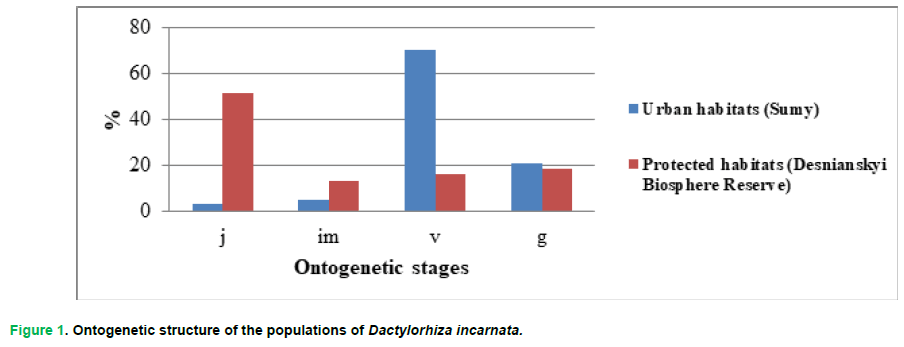
Figure 1: Ontogenetic structure of Dactylorhiza incarnata populations in urban habitats (Sumy) and protected habitats (Desnianskyi biosphere reserve).
In contrast, the population within the protected habitat (Desnianskyi biosphere reserve) demonstrated a spectrum dominated by juvenile individuals. The proportions of immature, virginal, and generative plants did not exceed 20% for each ontogenetic group. Such a structure reflects a shift toward early ontogenetic stages and indicates intensified recruitment processes. From a demographic perspective, this spectrum can be interpreted as a rejuvenated (invasive-type) population, characterized by a high proportion of young individuals and reduced representation of mature reproductive plants. This pattern suggests active population renewal under protected environmental conditions, possibly associated with favorable microhabitat characteristics and reduced anthropogenic disturbance.
Thus, while the Urban population exhibits features of a mature and relatively stable demographic structure, the Protected population corresponds to a rejuvenated (invasive) type, reflecting ongoing colonization or recovery processes (Pylypiv and Kyyak, 2021). The observed differences likely result from variation in disturbance regimes, hydrological conditions, vegetation competition, and habitat management. These factors influence the balance between recruitment, vegetative persistence, and reproductive output, ultimately shaping long-term population stability.
Overall, the contrasting demographic types recorded in urban and protected habitats highlight the ecological plasticity of D. incarnata and emphasize the importance of habitat-specific conditions in determining ontogenetic structure and population trajectory.
Conclusion
The study revealed morphometric variability of Dactylorhiza incarnata populations in urban and protected habitats, confirming the species’ ecological plasticity under different environmental conditions. Morphometric parameters varied depending on habitat type, reflecting adaptive responses of plants to anthropogenic pressure in urban ecosystems (Sumy) and more favorable ecological conditions in the Desnianskyi biosphere reserve. Urban populations were characterized by relatively stable morphometric structure with moderate development of vegetative and generative traits, while protected habitat populations showed higher variability associated with recruitment processes and ontogenetic heterogeneity. The observed morphometric differentiation indicates that habitat conditions, moisture regime, and interspecific competition play key roles in shaping population structure. The obtained results contribute to understanding ecological adaptation and conservation biology of D. incarnata in urbanized and protected environments.
References
- Belan SS. (2015). State of populations of rare plant species on floodplain meadows of the Psel river basin. Ph.D. thesis in Biological Sciences. Kyiv. 353.
- Zlobin Yu.A., Skliar V.G., Klymenko G.O. (2022). Biology and ecology of phytopopulations. Sumy: Universsty Book. 512.
- Lukash AV, Andrienko TL. (2011). Rare and protected plants of Polesie. Phytosociocenter. 167.
- Vykhor B, Prots B. (2018). Impact assessment of invasive plant species on natural and semi-natural habitat types of the Transcarpathia. Studia Biologica.
- Harrap A., Harrap S. (2009). Orchids of Britain and Ireland. Bloomsbury Publishing. 480.
- Bilz M, Kell SP, Maxted N, Lansdown RV. (2011). European red list of vascular plants. Publications Office of the European Union.
- Convention on Biological Diversity (CBD). (2020). Global biodiversity outlook 5. Secretariat of the Convention on Biological Diversity.
- Intergovernmental Science-Policy Platform on Biodiversity and Ecosystem Services (IPBES). (2019). Global assessment report on biodiversity and ecosystem services of the intergovernmental science-policy platform on biodiversity and ecosystem services. IPBES Secretariat.
- International Union for Conservation of Nature (IUCN). (2023). The IUCN Red List of threatened species. Version 2023-1.
- Klimenko HO, Yu LS, Honcharova NV. (2018). Populations of Dactylorhiza incarnata (L.) Soó in anthropogenically transformed habitats. In Proceedings of the International Scientific and Practical Conference. Sumy National Agrarian University.
- Pimm SL, Jenkins CN, Abell R, Brooks TM, Gittleman JL, Joppa LN, Raven PH, Roberts CM, Sexton JO. (2014). The biodiversity of species and their rates of extinction, distribution, and protection. Science. 344:1246752.
- Yu P and Kyyak V. (2021). Natural and anthropogenic threats to populations of Orchidaceae species. Visnyk of Kharkiv National University. Biology Series. 3:82-97.
- Tilman D, Isbell F, Cowles, JM. (2014). Biodiversity and ecosystem functioning. Annu Rev Ecol Evol Syst. 45:47-493.
- United Nations Environment Programme (UNEP). (2022). Environmental impacts of the war in Ukraine: A preliminary assessment. Nairobi: UNEP.