Research Article - Modern Phytomorphology ( 2026) Volume 20, Issue 2
Formation of biometric indicators and soybean seed yield depending on agricultural technology elements under irrigation conditions
Yaroslav Hadzalo1, Rayisa Vozhehova2, Yaroslav Likar3, Tetiana Marchenko2* and Oksana Tonkha32Institute of Climate-Smart Agriculture, National Academy of Agrarian Sciences of Ukraine, Odessa, Ukraine
3National University of Life and Environmental Sciences of Ukraine, Kyiv, Ukraine
Tetiana Marchenko, Institute of Climate-Smart Agriculture, National Academy of Agrarian Sciences of Ukraine, Odessa, Ukraine, Email: tmarchenko74@ukr.net
Received: 30-Jan-2026, Manuscript No. mp-26-183583; Accepted: 08-Apr-2026, Pre QC No. mp-26-183583 (PQ); Editor assigned: 02-Feb-2026, Pre QC No. mp-26-183583 (PQ); Reviewed: 30-Mar-2026, QC No. mp-26-183583; Revised: 07-Apr-2026, Manuscript No. mp-26-183583 (R); Published: 13-Apr-2026 , DOI: 10.5281/zenodo.19659443
Abstract
Aim: To improve systems for protecting soybean varieties from pests under irrigated conditions.
Methods: A set of general scientific methods and approaches of empirical and theoretical knowledge was applied: abstract-logical, statistical, modeling, generalization; two-factor field experiment.
Results: The effectiveness of protecting soybean varieties from harmful organisms when using biological and chemical preparations with drip surface irrigation in the Steppe of Ukraine was established. The Diona variety demonstrated the highest yield during the third sowing period “20 May” with a seed yield reaching 3.78 t/ha. In the variant with the Danai variety, the highest grain yield of 4.04 t/ha was recorded during the third sowing period, the Svyatogor variety showed the highest grain yield during the third sowing date “20 May” sowing period -4.17 t/ha.
Conclusion: Chemical plant protection was more effective than biological methods: when growing the Danai variety, the additional grain yield relative to the control plots was on average 0.39 t/ha (11.4%), and for the Diona and Svyatogor varieties -0.31 and 0.22 t/ha, or 8.3 and 5.5%, respectively. Biological protection of soybean varieties from harmful organisms was less effective than chemical protection, but it is advisable to use it in organic farming for the production of environmentally friendly products.
Keywords
Soybean, Height of soybean plants, Height of attachment of the lower pod in soybean plants, Seed yield
Introduction
Soybean is a strategic and market-oriented crop of modern agriculture. Due to its unique chemical composition, the use of its seeds can improve the solution to the problem of vegetable protein (Grabovska, et al, 2020, Fahrizal, et al. 2017). Although the area under soybean cultivation has grown rapidly over the past two decades, yields are still low. Among the factors that hinder the increase in soybean seed production, it is worth mentioning the imperfection of individual elements of zonal technologies for its cultivation, which is especially noticeable when introducing new varieties zoned for this zone into production (Kalenska, et al. 2017, Saritha, et al. 2019). The main factors in the formation of agroecological conditions for each soybean production facility are sowing dates, morpho biological characteristics of the variety, and the completeness and quality of technological processes (Grabovsky, et al. 2023, Yurkevich, et al. 2022).
Biometric indicators of soybean varieties have a significant impact on grain formation. A high correlation has been established between biometric indicators of soybean genotypes and yield at different plant densities and sowing dates (Ivaniv, et al. 2023).
The height of the lower bean is of great importance in soybean growing technology, and can be regulated by the genotype of the variety and agrotechnical measures (Furman, et al. 2022).
Materials and Methods
The aim of our research was to study the influence of variety genotype, sowing dates, and plant protection measures on the formation of plant biometric indicators and seed yield of soybean varieties under irrigated conditions.
The research was conducted during 2023-2025 at the experimental field of the Institute of Irrigated Agriculture of the NAAS of Ukraine, located in the southwestern part of the Kherson region, 12 km from the city of Kherson on the lands of the Ingulets irrigation system.
A three-factor experiment (factor A-variety, B-sowing date, C-plant protection system) was established using a randomized split-block design. Replication was fourfold, the sown area of the third-order plot was 75 m2, the accounting area was 50 m2 (Ushkarenko, et al. 2014).
In the plant protection system, the biological preparation “Biospectr BT” from the Biotechnology Engineering Institute was used. The active ingredient of the drug is mycelium, spores of the fungus of the genus Trichoderma and rhizosphere bacteria of the genus Pseudomonas with a titer of not less than 2.0.1010 CFU/cm3, as well as biologically active substances produced by producer strains. Also used was the synthetic chemical insecticide Bi-58 (active ingredient: Dimethoate; manufacturer: BASF) and fungicide Abacus (Badische Anilin and Sodafabrik).
The soil at the experimental site was typical of the Southern Steppe of Ukraine. The humus content in the arable layer was 2.61%, the content of available phosphorus (P2O5) was 59 mg/kg of soil, exchangeable potassium (K2O)-276 mg/kg and nitrates-16.3 mg/kg, the pH of the aqueous extract in the arable layer was 7.0.
Crop treatment was carried out using a Euro-Pulve compressor-type boom sprayer (bicycle model) equipped with TeeJet XR11003-VP nozzles. The working fluid consumption was 250 l/ha, the working pressure was 3.0 kPa/atm, with six nozzles and a sprayer boom working width of 3 m.
The grain yield of soybean varieties was determined by harvesting with a Sampo 130 combine harvester, followed by measuring the grain harvest moisture content and converting the yield to standard moisture content (14%). The generally accepted research methodology was used (Vozhegova, et al. 2021).
Results
Plant height of soybean varieties
The height of soybean crops is directly related to their productivity. Also, tall soybean plants have a well-developed root system that is able to effectively use moisture from the lower layers of the soil, which is especially important in arid climates.
The height of soybean plants fluctuated in a very wide range depending on the varietal warehouse and changed to a lesser extent under the influx of terms of soybean growth and the entry into the production of soybean plants (Fig. 1).
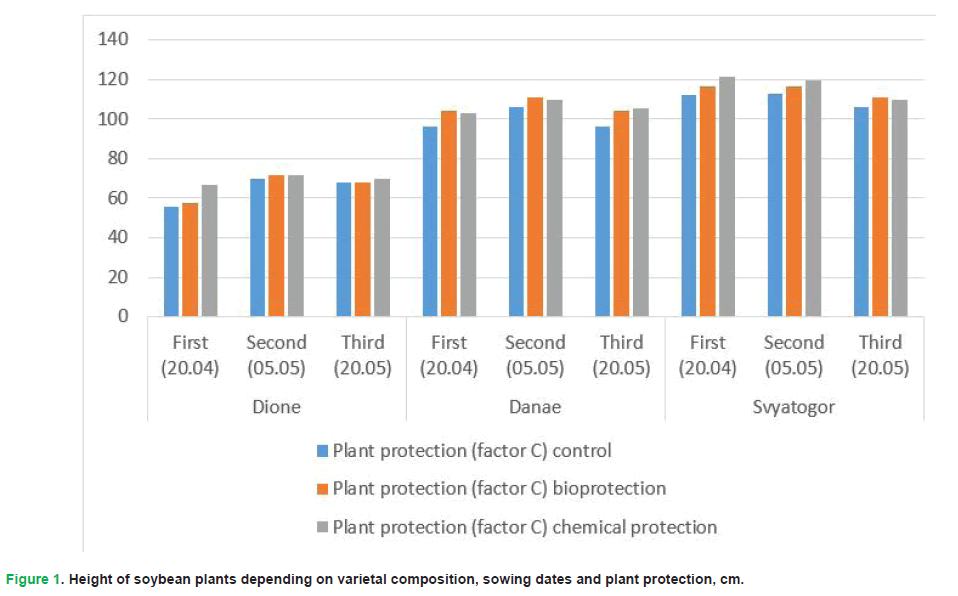
Figure 1: Height of soybean plants depending on varietal composition, sowing dates and plant protection, cm.
The final growth rate reached its highest value (121.3 cm) in the variety “Svyatogor” when sowed in the first term and dried with chemical protection of the plants. The height of the shoots changed 2.2 times (up to 55.7 cm) in the variety “Diona” when sowed in the first term (20.04 cm) leveled with the control variant (watering with clean water). Based on the varietal warehouse, the average absolute dominance of the variety “Svyatogor” was achieved by the first official, who demonstrated the highest height of the plant -113.8 cm. For the variety “Danaya” there was a change in the height of the plant by 9.5% (up to 104.0 cm). The smallest height of the plant-just 66.5 cm-was found in the “Diona” variety, which was 56.4% less than in the “Danaya” variety, and 71.2% less in the “Svyatogor” variety.
Bean attachment height
The height of lower pod attachment is directly related to the height of the shoots and is important for catching a high-yield crop. If the pods are located close to the soil surface, they can be lost during harvesting. Therefore, when harvesting soybeans with a combine, the height of lower pod attachment should be at least 12 cm from the soil surface. Also, increasing the height of the lower soybean is facilitated by reducing the row width when sowing soybeans.
The difference in the height of the lower soybean was threefold, and the maximum level of this indicator, 29.7 cm, was achieved in the variant with the “Svyatogor” variety when sowing in the first term and observing the chemical system of soybean protection from pests. The lowest value of this indicator -9.8 cm was noted in the variant with the “Diona” variety when sowing also in the first term “20 April” and without the use of biological or chemical plant protection products (Fig. 2).
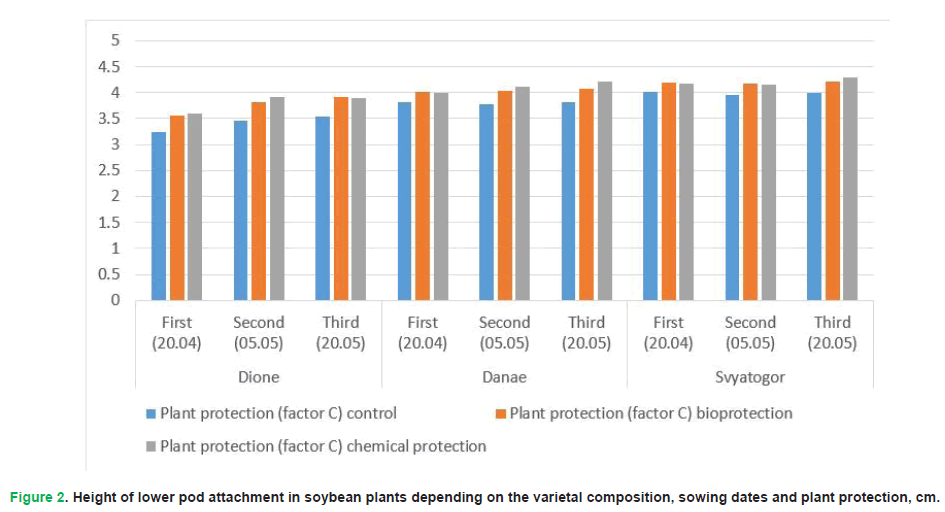
Figure 2: Height of lower pod attachment in soybean plants depending on the varietal composition, sowing dates and plant protection, cm.
The genotype significantly influenced the height of lower pod attachment. In the soybean variety Diona, this indicator had the lowest level-on average 11.1 cm. When growing the Danaya variety, it increased by 70.3% (up to 18.9 cm). The height of lower pod attachment was formed in the Svyatogor soybean variety, on average by the coefficient A of 25.9 cm, which is 36.8% higher than in the Danaya soybean variety and 2.3 times higher than in the Diona soybean variety.
Grain yield
Yield indicators of cultivated soybean seeds were maximum (at the level of 4.30 t/ha) in the variant with the Svyatogor variety in the third sowing period and with chemical plant protection (Fig. 3).
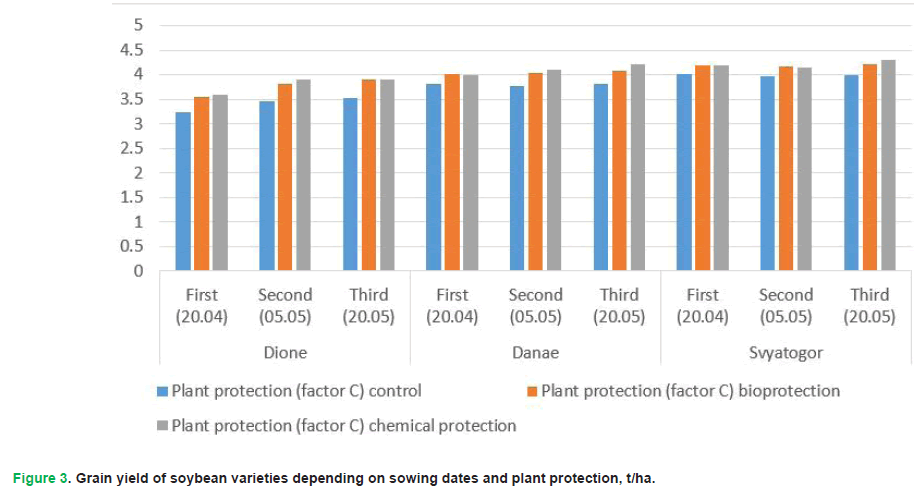
Figure 3: Grain yield of soybean varieties depending on sowing dates and plant protection, t/ha.
Its decrease by 1.3 times (to 3.24 t/ha) occurred in areas where the Diona variety was sown in the first sowing period “20 April” and no biological or chemical plant protection products were used.
Growing the Svyatogor variety resulted in the formation of the maximum level of soybean seed yield in irrigated experimental plots (on average by factor -4.13 t/ha). In the variant with the Danaya variety, the studied indicator slightly decreased by 0.15 t/ha, or by 3.7%. The lowest average seed yield was recorded in the variant with the Diona variety-3.66 t/ha, which is 8.9-13.0% less than in other varieties.
Regarding sowing dates (factor B), when sowing the Diona variety, the second and third terms were preferred with seed yield within 3.73-3.78 t/ha, and in the first term, its decrease by 7.8-9.2% was noted. In the variant with the Danaya variety, a slight increase in this indicator was observed in the third sowing date “20 May”, but the difference between the studied variants by this factor was small-only 0.8-2.5%. A similar trend was recorded in the variant with the Svyatogor variety, where a slight increase by 0.8-1.1% was shown in the first “20 April” and third “20 May” sowing dates.
Thanks to the use of chemical and biological protection, the yield of the Diona variety on the second sowing date was stably maintained at a level of 0.30-0.33 t/ha. On average, according to factor C, the use of biological agents resulted in a yield increase of about 0.35 t/ha of seeds when cultivating the Diona variety, which is 10.3% of the yield in the reference variant with treatment with plain water. For the soybean varieties Danaya and Svyatogor, the yield increase from the use of biological protection was lower: for Danaya -0.24 t/ha (or 6.4%), and for Svyatogor -0.20 t/ha (or 5.1%).
Chemical plant protection proved more effective than biological control, but this improvement had some drawbacks. When cultivating the “Danaia” variety, the surplus seed yield, relative to control plots, averaged 0.39 t/ha (11.4%), while for the “Danaia” and “Svyatogor” varieties, it was 0.31 and 0.22 t/ha, or 8.3 and 5.5%, respectively.
The results indicate that biological protection of crops from diseases and insects, in addition to increasing grain yields, has made it possible to produce environmentally friendly products and protect the environment. This demonstrates the attractiveness of using biotechnological compounds in irrigated soybean cultivation to protect crops from pests, either as a substitute for agrochemicals or as an additional component in comprehensive soybean protection schemes.
Discussion
Considering the strategy adopted by the European Union countries for the “Green Deal (GD)” in agriculture, which envisages a radical reduction in the near future in the use of chemical plant protection products and mineral fertilizers in food production, as well as a reduction in the negative pressure on the environment of crop cultivation technologies, the use of biological methods in protecting plants from harmful organisms is relevant and timely (Gadzalo and Luzan, 2023).
In modern world agricultural production, the direction aimed at the environmental friendliness of agriculture is rapidly gaining popularity. Biological method of plant protection (biological control or biocontrol) in its narrow classical sense is a means of combating pests, weeds and plant diseases using natural enemies. It is based on natural mechanisms (“predator-prey”, “parasite-host”) with active human intervention in the process of regulation and suppression of pests and pathogenic organisms (Krutiakova, 2020).
To obtain the maximum yield of soybean grain under irrigated conditions, it is necessary to develop an individual technology for each genotype, which allows to reveal its potential. Varietal reactions were established for each region, the best genotypes and improved elements of technologies were recommended, which indicates the need to improve varietal technology in each agro-ecological zone (Ivaniv, et al. 2023, Didora, et al. 2022, Milenko, et al. 2022).
The results of our research confirm the conclusions of the above author’s developments regarding the development of varietal technologies for growing soybeans, taking into account the plant protection system, varietal response, and reducing the pesticide load on agricultural landscapes.
Conclusion
It was determined that the development of soybean shoot height is influenced by species characteristics and the studied components of agricultural technology. Sowing periods had varying degrees of influence on the development of soybean shoot height. For example, for the ‘Diona’ variety, an increase in shoot height to a maximum of 71.0 cm was recorded during the second sowing period “5 May”. When cultivating the ‘Danaia’ variety, the maximum studied value of 108.7 cm also occurred during sowing in the second period. For the ‘Svyatogor’ variety, the maximum shoot height of 116.5 cm was reached during the first sowing period. Increased shoot resistance contributed to height growth: when using the biological shoot protection method, shoot height increased by 4.6% (to 95.6 cm), and with agrochemical shoot protection, the maximum shoot height of 97.3 cm was reached.
The Diona soybean variety demonstrated the highest yield on the third sowing date “20 May”, with a seed yield of 3.78 t/ha. The Danaya variety achieved the highest seed yield of 4.04 t/ha on the third sowing date, while the Svyatogor variety demonstrated the highest seed yield on the third sowing date “20 May”, at 4.17 t/ha.
Chemical crop protection is more effective than biological: when cultivating the Danaya variety, the additional seed yield relative to the control plots averaged 0.39 t/ha (11.4%), and for the Danaya and Svyatogor varieties -0.31 and 0.22 t/ha, or 8.3 and 5.5%, respectively.
References
- Didora V, Romanchuk L, Kliuchevych M, Vyshnivskyi P, Matviichuk N. (2022). Varietal features of elements of organic soybean cultivation technology. Scientific Horizons. 25:60-68.
- Fahrizal I, Rahayu A, Rochman N. (2017). The response of soybean plants of mycorrhizal abuscules and application of phosphorus fertilizers in acid soils. J Agronida. 3:95-105.
- Furman VA, Furman ÐV, Svystunova IV. (2022). Dynamics of stand density and survival of soybean plants depending on mineral fertilization and inoculation in the conditions of the right-bank forest-steppe. Scientific reports of the NUBiP of Ukraine. 5.
[Crossref]
- Gadzalo IA, Luzan Yu. (2023). Increasing the role of agricultural science at the stage of European integration. Bull Agrar Sci. 12:5-16.
- Grabovska T, Lavrov V, Rozputnii O, Grabovskyi M, Mazur T, Polishchuk Z, Prisjazhnjuk N, Bogatyr L. (2020). Effect of organic farming on insect diversity. Ukrainian J Ecol. 10:96-101.
[Crossref]
- Grabovskyi MB, Nimenko SS. (2023). Formation of the height of soybean plants using organic cultivation technology. Taurian Scientific Herald. 129:54-63.
- Ivaniv M, Vozniak V, Marchenko T, Baklanova T, Sydiakina O. (2023). Varietal features of elements of soybean cultivation technology during irrigation. Scientific Horizons. 26:85-96.
- Kalenska SM, Yeremenko OA, Taran VG, Krestyaninov EV, Ryzhenko AS. (2017). Adaptability of field crops under variable growing conditions. Scientific works of the Institute of Bioenergy Crops and Sugar Beet. 25:48-57.
- Krutiakova VI. (2020). Biomethod is the basis of sustainable development of domestic agriculture. Herald of Agrarian Science. 10:5-14.
- Milenko O, Shevnikov M, Solomon Yu., Rybalchenko A, Shokalo N. (2022). Influence of foliar top-dressing on the yield of soybean varieties. Scientific Horizons. 25:61-66.
- Saritha M, Tollamadugu NVKVP. (2019). The status of research and application of biofertilizers and biopesticides: Global scenario. Recent Dev Appl Microbiol Biochem. 15:195-207.
- Vozhegova RA, Lavrynenko YO, Malyarchuk MP. (2021). Methodology of field and laboratory research on irrigated lands. Kherson: Grin D.S. 286.
- Yurkevich EO, Valentyuk NO, Kohut IM, Yevych VS. (2022). High-oleic sunflower is an innovative way for further sustainable development of organic agriculture of the southern region and preserving soil fertility. Taurida Scientific Herald. 125:104-110.