Research Article - Modern Phytomorphology ( 2025) Volume 19, Issue 6
Exploring seedling morphology for taxonomic delimitation and phylogenetic insights in the genus Euphorbia
Nabeela MAHMOOD1, Sahar ZAIDI1, Muniza RIAZ1, Huma QURESHI2* and Tauseef ANWAR32Department of Botany, University of Chakwal, Chakwal-48800, Pakistan
3Department of Botany, The Islamia University of Bahawalpur, Bahawalpur-63100, Pakistan
Huma QURESHI, Department of Botany, University of Chakwal, Chakwal-48800, Pakistan, Email: huma.qureshi@uoc.edu.pk
Received: 31-Jul-2025, Manuscript No. mp-25-152748; Accepted: 16-Dec-2025, Pre QC No. mp-25-152748 (PQ); Editor assigned: 04-Aug-2025, Pre QC No. mp-25-152748 (PQ); Reviewed: 13-Oct-2025, QC No. mp-25-152748; Revised: 15-Oct-2025, Manuscript No. mp-25-152748 (R); Published: 23-Dec-2025, DOI: 10.5281/zenodo.18427078
Abstract
This study investigates the taxonomic significance of seedling morphology in the genus Euphorbia, with emphasis on identifying and differentiating species during their juvenile stages. Key morphological traits including leaf shape, apex, base, venation pattern, and surface texture were analyzed across four Euphorbia species. The study employs both conventional morphological analyses and numerical taxonomic techniques, revealing distinct differences among species, namely E. hirta, E. serpens, E. hypericifolia, and E. prostrata. A dendrogram was constructed to illustrate phylogenetic relationships among the species, confirming the diagnostic value of seedling morphology for species identification. The results highlight the effectiveness of seedling morphological markers in species classification and offer new insights into taxonomic relationships within the genus. This study addresses a significant gap in Euphorbia seedling morphology research, providing a robust framework for future taxonomic and conservation studies, and encouraging further exploration of this diverse and complex genus.
Keywords
Cladogram analysis, Euphorbia species, Morphological variation, Phylogenetic relationships, Seedling morphology, Taxonomic differentiation
Introduction
The family Euphorbiaceae, commonly known as the ‘spurge family,’ is among the largest and most diverse families of angiosperms, comprising approximately 7,500 species distributed across 300 genera. Members of this family occupy a wide range of habitats from tropical and temperate regions to grasslands, deserts, and coastal zones contributing significantly to global floral diversity (Gilbert, 1987, Carter, 1994, Bruyns, et al. 2006, Riina, et al. 2013, Bolaji, et al. 2014). Euphorbia, the largest genus within the Euphorbiaceae family, represents one of the most taxonomically complex and ecologically versatile plant groups, with approximately 2,000 species distributed worldwide (Bruyns, et al. 2006, Horn, et al. 2012). In Pakistan, the genus comprises 111 species thriving across diverse ecosystems from arid deserts to fertile grasslands demonstrating remarkable ecological adaptability, ranging from arid deserts to fertile grasslands, and showcasing remarkable adaptability in terms of growth forms-ranging from small herbs to large trees and xerophytic forms (Fayed, et al. 2007, Dorsey, et al. 2013). This extensive species and habitat diversity has made Euphorbia an important subject in plant taxonomy, with research focusing on molecular phylogeny, anatomy, and seed, capsule, and fruit morphology (Steinmann and Porter, 2002, Bruyns, et al. 2006, Gales and Toma, 2006, Aldhebiani and Jury, 2013, Da Silva, et al. 2016, Genc, et al. 2018).
Pakistan’s contribution to Euphorbia taxonomy is noteworthy, with 52 species described in the national flora (Euphorbiaceae, No. 172, 1986), accompanied by detailed descriptions of vegetative and floral traits and comprehensive identification keys. However, despite these efforts, a substantial knowledge gap persists regarding the genus’s juvenile phase, particularly in seedling morphology, which has the potential to offer valuable insights for species identification and classification. Seedling morphology remains an underexplored yet valuable aspect of plant taxonomy, offering a cost effective and reliable approach to species differentiation at early developmental stages. It provides an alternative approach to more traditional, resource-intensive taxonomic methods and also contributes to plant conservation by facilitating the early detection and protection of endangered taxa (Lopez, et al. 1998, Tillich, 2000, Das, et al. 2001, Ibarra-Manriquez, et al. 2001, Linder and Caddick, 2001, Shulkina, et al. 2003, Sinjushin and Akopian, 2011, Lira Lopes and de Souza, 2015, Abozeid, et al. 2017, Bose, et al. 2017, Mehmood, et al. 2018, Mahmood, et al. 2018). The significance of seedling morphology in plant taxonomy has been emphasized by many researchers, underscoring its usefulness in both species’ delimitation and evolutionary studies. The work of Verdus, 1976 serves as a pivotal contribution, as it explored seedling and cotyledonary characteristics of 131 Euphorbiaceae species, establishing a foundation for understanding evolutionary trends in this family. However, this research encompassed only a limited subset of species, indicating the need for further exploration. Additionally, early studies on Indian tree species by Lubbock, 1892 and Troup, 1921 expanded the understanding of seedling characteristics within the genus.
This study builds upon previous research by examining the role of seedling morphology in the taxonomy of Euphorbia and related taxa within the Euphorbiaceae family. By analyzing seedling morphological features, this study aims to enhance species identification accuracy and offer new insights into the evolutionary and taxonomic relationships within the family. Such studies are critical for advancing plant systematics and play a significant role in the conservation and management of biodiversity. Given the vast number of Euphorbia species yet to be thoroughly studied, this research provides a timely contribution toward addressing existing knowledge gaps within this taxonomically significant genus.
Materials and Methods
In this study, five species of the genus Euphorbia-E. prostrata, E. cyathophora, E. hirta, E. serpens, and E. hypericifolia-were examined for their seedling morphological characteristics. Multiple specimens of each species, representing various seedling stages, were collected from the M.Sc. Block, Federal Urdu University of Arts, Science and Technology, Gulshan Campus, Karachi. Collected specimens were maintained in a greenhouse under controlled conditions to monitor and document their developmental stages. The recorded data included detailed morphological descriptions of cotyledons, the first leaf pair, and subsequent leaves. Interrelationships among the species were analyzed using cluster analysis, and dendrograms were constructed with SPSS software. Photographs of the taxa were captured using a Nikon D3200 digital camera. The investigated taxa are listed below:
• Euphorbia hirta L. (NM 115)
• Euphorbia hypericifolia L. (NM 941)
• Euphorbia prostrata Ait (NM 329)
• Euphorbia serpens Kunth. (NM 361)
Results
Morphological characterization of Euphorbia species
The morphological traits of the four Euphorbia species-Euphorbia hirta L., E. hypericifolia L., E. prostrata Ait., and E. serpens Kunth-were analyzed in detail to differentiate among their seedling structures, paracotyledons, and leaf characteristics.
Euphorbia hirta L.: The seedling of E. hirta exhibits epigeal, phanerocotylar germination. The hypocotyl is white, round, soft, and glabrous, measuring 0.1-0.3 cm in length. Paracotyledonary leaves are reddish-green, opposite, and oblong, with obtuse apices and bases, entire margins, and indistinct midrib. Internodes are red, round, pubescent, and 1-2 cm apart. The first two leaves are green, horizontal, and sub-sessile, with an obovate shape, obtuse-acute apex, and entire margins. Subsequent leaves are lanceolate-ovate, petiolate, and exhibit serrate margins with distinct pinnate venation.
Euphorbia hypericifolia L.: The seedling of E. hypericifolia is also epigeal and phanerocotylar. Its hypocotyl is red, round, soft, and glabrous, about 2 cm long. Paracotyledonary leaves are green and obovate, with cuneate bases and entire margins. Internodes are red, round, glabrous, and spaced approximately 1 cm apart. The first two leaves are oblong, stipulated, and petiolated, with obtuse apex and entire margins. Subsequent leaves are narrow elliptic with serrulate margins and multicostate venation.
Euphorbia prostrata Ait.: The seedling of E. prostrata is epigeal and phanerocotylar, with a red, round, erect, and glabrous hypocotyl about 1 cm long. Paracotyledonary leaves are green, ovate, with obtuse apex, entire margins, and indistinct midrib. Internodes are whitish-green, round, glabrous, and spaced up to 2 cm apart. The first two leaves are obovate, with cuneate base and entire margins, while subsequent leaves are obovate, with serrate margins and a distinct midrib.
Euphorbia serpens Kunth: The seedling of E. serpens is epigeal and phanerocotylar, with a green, round, soft, and glabrous hypocotyl about 1 cm long. Paracotyledonary leaves are oblong, green, sub-sessile, and glabrous. Internodes are reddish-green, glabrous, and less than 1 cm apart. The first two leaves are ovate, retuse, and glabrous, while subsequent leaves are ovate-orbicular, emarginate, and exhibit entire margins with distinct midrib.
Comparative morphological analysis
The morphological data for paracotyledons, first two leaves, and subsequent leaves are presented in Tabs. 1, 2, and 3, respectively. These analyses reveal distinct interspecific differences among the four Euphorbia species. The paracotyledons of E. hirta and E. serpens share an oblong shape, a trait that clusters them together morphologically. In contrast, E. hypericifolia exhibits obovate paracotyledons, while E. prostrata displays ovate ones. These variations serve as critical markers for species differentiation.
| Plant Name | Shape | Apex | Base | Margin | Venation | Surface |
|---|---|---|---|---|---|---|
| E. hirta | Oblong | Obtuse | Obtuse | Entire | Indistinct | Glabrous |
| E. hypericifolia | Obovate | Obtuse | Cuneate | Entire | Indistinct | Glabrous |
| E. prostrata | Ovate | Obtuse | Obtuse | Entire | Indistinct | Glabrous |
| E. serpens | Oblong | Obtuse | Obtuse | Entire | Indistinct | Glabrous |
Table 1. Morphological characters of species’ paracotyledons.
| Plant Name | Type | Phyllotaxy | Shape | Apex | Base | Margin | Venation | Surface |
|---|---|---|---|---|---|---|---|---|
| E. hirta | Simple | Opposite | Obovate | Obtuse-cuneate | Obtuse | Entire | Pinnate alternate | Pubescent |
| E. hypericifolia | Simple | Opposite | Oblong | Obtuse | Obtuse | Entire | Pinnate opposite | Glabrous |
| E. prostrata | Simple | Opposite | Obovate | Obtuse | Cuneate | Entire | Distinct | Glabrous |
| E. serpens | Simple | Opposite | Ovate | Retuse | Oblique | Entire | Distinct | Glabrous |
Table 2. Morphological characters of species’ first two leaves.
| Plant Name | Type | Phyllotaxy | Shape | Apex | Base | Margin | Venation | Surface |
|---|---|---|---|---|---|---|---|---|
| E. hirta | Simple | Opposite | Lanceolate-ovate | Acute | Oblique | Serrate | Pinnate alternate | Pubescent |
| E. hypericifolia | Simple | Opposite | Narrow elliptic | Acute | Obtuse | Serrulate | Multicostate | Glabrous |
| E. prostrata | Simple | Opposite | Obovate | Obtuse | Oblique | Serrate | Distinct | Glabrous |
| E. serpens | Simple | Opposite | Ovate- orbicular | Emerginate | Oblique | Entire | Distinct | Glabrous |
Table 3. Morphological characters of species’ subsequent leaves.
Further morphological distinctions were evident in the first two leaves, particularly in their shape, apex, base, margins, and surface texture. For instance, the first two leaves of E. hirta are horizontal and sub-sessile with an obovate shape and a pubescent surface, whereas E. serpens has glabrous, ovate leaves. In E. hypericifolia, the first two leaves are characterized by an oblong shape with a cuneate base and entire margins, while E. prostrata exhibits broadly ovate leaves with rounded bases. These differences, coupled with unique venation patterns such as pinnate or multicostate venation, underscore the morphological diversity within the genus.
The subsequent leaves provided additional distinguishing features. E. hirta is notable for its lanceolate-ovate leaves, which contrast with the narrow elliptic leaves of E. hypericifolia. E. serpens exhibits ovate-orbicular leaves with entire margins, while E. prostrata displays broadly ovate leaves with a slightly serrated margin. Variations in venation, apex sharpness, and surface texture further contribute to the identification process, demonstrating the taxonomic significance of these morphological traits.
Artificial key and cladogram
An artificial key was constructed to facilitate the identification of these four species by focusing on distinctive morphological characteristics, particularly the shape, apex, and texture of paracotyledons and the first two leaves. The key emphasizes the unique obovate paracotyledons of E. hypericifolia and the pubescent surface texture of E. hirta, both of which serve as reliable identifiers.
Key to the species
1+ Paracotyledons oblong …………………………………………………………… 2
1- Paracotyledons not oblong ……………………………………………………..…. 3
2+ The first two leaves obovate, pubescent, size …………………………….. E. hirta
2- The first two leaves ovate, glabrous, size ………………………..…..…... E. serpens
3+ Paracotyledons obovate, first two leaves oblong………………... E. hypercifolia
3- Paracotyledons ovate, first two leaves obovate …………….…….. E. prostrata
Cluster II is also divided into two sub-clusters A and B. IIA presented variation among first two leaves and subsequent leaves of E. serpens on the basis of leaf shape (ovate, orbicular) and apex (retuse, emerginate) as well as among first two leaves and subsequent leaves of E. prostrata based on leaf base (cuneate, oblique) and margin (entire, serrate). IIB consist of single species E. hirta which is morphologically distinct from other species in Cluster II.
To complement the artificial key, a cladogram (Fig. 1) was constructed to visualize the morphological relationships among the studied species. The cladogram reveals two main clusters. Cluster I include sub-cluster IA, which groups E. hirta and E. serpens based on their shared oblong paracotyledons. Sub-cluster IB separates E. hypericifolia due to its narrow elliptic subsequent leaves and distinct venation pattern.
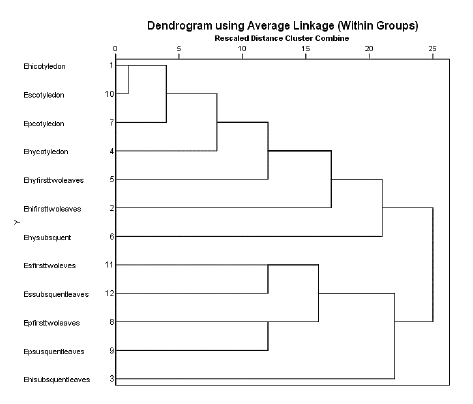
Figure 1: Dendrogram illustrating the phylogenetic relationships among four Euphorbia species. (Ehicotyledon-E. hirta cotyledons, Escotyledon-E. serpens cotyledons, Epcotyledon-E. prostrata cotyledons, Ehycotyledon-E. hypercifolia cotyledons, Ehifirsttwoleaves-E. hirta first two leaves, Esfirsttwoleaves-E. serpens first two leaves, Epfirsttwoleaves-E. prostrata first two leaves, Ehyfirsttwoleaves-E. hypercifolia first two leaves, Ehisubsequentleaves-E. hirta subsequent leaves, Essubsequentleaves-E. serpens subsequent leaves, Epsubsequentleaves-E. prostrata subsequent leaves, Ehysubsequentleaves-E. hypercifolia subsequent leaves).
Cluster II highlights the morphological divergence of E. prostrata and E. serpens based on differences in leaf base and apex characteristics. Sub-cluster IIB distinctly isolates E. hirta, characterized by its lanceolate-ovate leaves and unique surface texture. These clustering patterns highlight morphological affinities among Euphorbia species, providing a systematic framework for their classification.
Overall, this comparative morphological analysis highlights the taxonomic significance of paracotyledon and leaf traits, providing a strong framework for the identification and systematic understanding of Euphorbia species.
Discussion
The morphological attributes of the studied seedlings hold significant taxonomic importance, as seedling morphology serves as a valuable tool for identifying species at their juvenile stages. Accurate identification of species during early growth stages is crucial in both natural ecosystems and horticultural settings. Similar observations were reported by Mangaly, et al. 1978, who examined two Euphorbia species-E. hirta and E. thymifolia-and highlighted distinct morphological differences in their seedlings. These differences can be effectively used for taxonomic classification, reinforcing the importance of seedling traits for species identification. The present findings align with those of Ogie-Odia, et al. 2019, who emphasized that morphological diversity within Euphorbiaceae serves as a key criterion for taxonomic differentiation. Specific attributes such as paracotyledon shape, leaf morphology, and venation patterns have shown that species like E. hirta, E. serpens, E. hypericifolia, and E. prostrata possess unique seedling characteristics that make them identifiable even at early growth stages. This is in line with previous studies that have emphasized the utility of seedling morphology for identifying species in the Euphorbiaceae family, as noted by De Souza, et al. 2014 and Pujol, et al. 2004. These studies highlight the role of seedling morphology in discriminating between species, thus contributing significantly to taxonomic clarity.
Beyond the Euphorbiaceae family, the significance of seedling morphology has been widely explored in other plant genera and families. Numerous studies have examined how variations in seedling traits aid in species identification and classification, further supporting the generality of these findings. Martin, et al. 2011, Sinjushin and Akopian, 2011, and Singh, 2012 contributed valuable insights into how seedling characteristics can serve as reliable taxonomic markers. Similarly, Karmakar, 2012, Khalik, 2012, and Gurgel, et al. 2012 demonstrated the importance of such traits in species identification within other genera. The breadth of research on seedling morphology across different plant families highlights its widespread applicability and value in resolving taxonomic ambiguities.
In addition to seedling morphology, the integration of numerical taxonomic techniques offers a more comprehensive approach to species classification. The use of numerical methods, which rely on the analysis of morphological traits, has been successfully employed in resolving taxonomic issues across various plant families. For example, Bello, et al. 2013 applied numerical taxonomic techniques to the genus Solanum, successfully resolving taxonomic uncertainties. In the present study, numerical methods such as cluster analysis were applied to classify the Euphorbia species based on their seedling characteristics. The clustering patterns observed in the dendrogram (Fig. 1) further illustrate the effectiveness of combining numerical taxonomy with morphological analysis. The clustering of E. hirta and E. serpens based on their shared paracotyledon shapes, and the separation of E. hypericifolia due to its narrow elliptic leaves, exemplify the strength of this combined approach.
Numerical taxonomic techniques have been widely applied across diverse species by several researchers, including El-Gazzar, 2008, who worked on Hyptis; Folorunsho and Jayeola, 2009, who studied Polystachya; and Kolawole, Abdulrahman, and Oladele, 2014, who focused on Jatropha. These studies highlight the utility of these techniques in examining morphological variations and resolving taxonomic uncertainties.
In addition to seedling traits, parameters such as seed and pollen morphology, along with ecological adaptations, also play vital roles in the delimitation of taxa. Research by Abid and Qaiser, 2009, Gontcharova, et al. 2009, and Celep, et al. 2012 highlighted the significance of seed morphology in species identification, while studies by Das, et al. 2013 and Abid, et al. 2014 explored the role of pollen morphology in understanding phylogenetic relationships. Furthermore, ecological studies by Song, Gu, and Liu, 2019 and Erdtman, 2023 have illustrated how environmental factors contribute to species differentiation. These diverse factors underscore the multifaceted approach required for accurate taxonomic classification and provide additional support for the value of seedling morphology as one of the key taxonomic tools.
While seedling morphology has been explored in many species, the majority of taxa within the genus Euphorbia remain understudied, and many species have yet to be classified based on their juvenile characteristics. The present study represents an initial yet significant step toward addressing this research gap. By documenting and analyzing the morphological characteristics of seedlings within this genus, we contribute to a better understanding of its diversity and taxonomic structure. Moreover, the study emphasizes the critical role that seedling morphology plays at various taxonomic levels, providing a foundation for further research and exploration.
In conclusion, this study underscores the pivotal role of seedling morphological traits in species identification and classification within the genus Euphorbia. The integration of numerical taxonomic techniques with traditional morphological observations provides a robust framework for species classification, as exemplified by the dendrogram analysis. Given the large number of unexamined species within this genus, further research on seedling morphology is essential to unravel the complete taxonomic diversity of Euphorbia and to provide accurate identification tools for researchers and practitioners in the field.
Conclusion
This study highlights the critical importance of seedling morphology in the taxonomic identification and classification of species within the genus Euphorbia. Through the detailed examination of key morphological traits and the application of numerical taxonomic techniques, this study provides new insights into species differentiation at the juvenile stage, thereby enhancing the understanding of their taxonomic relationships. The findings demonstrate that integrating traditional morphological analysis with numerical methods effectively resolves taxonomic ambiguities, particularly among understudied species. Furthermore, this research addresses a notable gap in the current literature, and provides a foundational basis for future investigations into the largely unexplored seedling morphology of Euphorbia species. Overall, this study lays the groundwork for future research aimed at improving species identification, classification, and conservation strategies within the genus.
Acknowledgment
None.References
- Abid R, Ather AFS, Qaiser M. (2016). The seed atlas of Pakistan. Papaveraceae. Pak J Bot. 48:1035-1044.
- Abid R, Kanwal D, Qaiser M. (2014). Seed morphological studies on some monocot families (excluding gramineae) and their phylogenetic implications. Pak J Bot. 46:1309-1324.
- Abid R, Qaiser M. (2009). Taxonomic significance of the cypsela morphology in the tribe Anthemideae (Asteraceae) from Pakistan and Kashmir. Pak J Bot. 41:555-579.
- Abozeid A, Turki Z, El-Shayeb F, Tang Z. (2017). Embryo and seedling morphology of some Trigonella L. species (Fabaceae) and their taxonomic importance. Flora. 230:57-65.
- Aldhebiani A, Jury S. (2013). Anatomical studies on the genus Euphorbia L. Saudi Arabia (Subgenera: Triucalli, Ermophyton, Esula and Chamaesyce). Int Res J Plant Sci. 4:168-191.
- Almeida OJ, Paoli AA, Souza LA, Cota-Sánchez JH. (2013). Seedling morphology and development in the epiphytic cactus Epiphyllum phyllanthus (L.) Haw. (Cactaceae: Hylocereeae). J Torrey Bot Soc. 140:196-214.
- Arman M, Gholipour A. (2013). Seed morphology diversity in some Iranian endemic Silene (Caryophyllaceae) species and their taxonomic significance. Acta Biol Szeged. 57:31-37.
- Ashfaq S, Ahmad M, Zafar M, Sultana S, Bahadur S, Ahmed SN, Nazish M. (2020). Pollen morphology of family Solanaceae and its taxonomic significance. An Acad Bras Ciênc. 92:e20181221.
- Bello AO, Oladipo OT, Saheed SA. (2013). Numerical taxonomic study of some Solanum L. species (Solanaceae) using vegetative and floral morphological characters. Ife J Sci. 15:523-534.
- Bolaji AO, Olojede CB, Famurewa AA, Faluyi JO. (2014). Morphological and cytological studies of Euphorbia hyssopifolia L. and Euphorbia heterophylla L. from Ile-Ife, Nigeria. Niger J Genet. 28:15-18.
- Bose A, Das P, Paria ND. (2017). Taxonomic treatment of some Indian Magnolia L. in respect to seedling morphology. Feddes Repert. 128:9-16.
- Bose A, Paria ND. (2015). Seed and seedling morphology in Cheilocostus speciosus (Costaceae). Phytomorphology. 65(3&4):109-113.
- Bruyns P, Mapay RJ, Hedderson T. (2006). A new subgeneric classification for Euphorbia (Euphorbiaceae) in southern Africa based on ITS and psbA-trnH sequence data. Taxon. 55:397-420.
- Carter S. (1994). A preliminary classification of Euphorbia subgenus Euphorbia. Ann Mo Bot Gard. 81:368-379.
- Celep F, Koyuncu M, Fritsch RM, Kahraman A, DoÄan M. (2012). Taxonomic importance of seed morphology in Allium (Amaryllidaceae). Syst Bot. 37:893-912.
- Da Silva OLM, Cordeiro Caruzo I, Caruzo MBR. (2016). Seed morphology in Euphorbia and its taxonomic applications: A case study in São Paulo, Brazil. Braz J Bot. 39:349-358.
- Das K, Bose A, Sanyal S, Paria ND. (2013). Seed morphology as an aid in taxonomic study of some aquatic monocotyledons. J Bot Soc Bengal. 67:11-19.
- Dorsey BL, Haevermans T, Aubriot X, Morawetz JJ, Riina R, Steinmann VW, Berry PE. (2013). Phylogenetics, morphological evolution, and classification of Euphorbia subgenus Euphorbia. Taxon. 62:291-315.
- Eicheberg MT, Scatena VL. (2013). Morphology and anatomy of the diaspores and seedlings of Paspalum (Poaceae, Poales). An Acad Bras Ciênc. 85:1389-1396.
- El-Gazzar A, Rabei S. (2008). Taxonomic assessment of five numerical methods and its implications on the classification of Hyptis sl (Labiatae). Int J Bot. 4:85-92.
- Erdtman G. (2023). Pollen morphology and plant taxonomy: Angiosperms (An Introduction to Palynology). Brill.
- Falorunso AE, Jayeola AA. (2009). Application of numerical taxonomy to lip morphology in the genus Polystachya Hook (Orchidaceae) in Nigeria. Not Bot Horti Agrobot Cluj-Napoca. 37:45-47.
- Fayed AA, Hassan NM. (2007). Systematic significance of the seed morphology and seed coat sculpture of the genus Euphorbia L. (Euphorbiaceae) in Egypt. Flora Mediterr. 17:47-64.
- Feitoza GV, Santos JUMD, Gurgel ESC, Oliveira DMT. (2014). Morphology of fruits, seeds, seedlings and saplings of three species of Macrolobium Schreb. (Leguminosae, Caesalpinioideae) in the Brazilian Amazon floodplain. Acta Bot Bras. 28:422-433.
- Horn JW, Van Ee, BW, Morawetz JJ, Riina R, Steinmann VW, Berry PE. (2013). Phylogenetic analysis and taxonomic revision of the American members of Euphorbia subgenus Chamaesyce (Euphorbiaceae). Taxon. 62:291-315.
- Hu P, Zhong C, Zhang Y, Jiang Q, Chen Y, Chen Z, Bush D. (2016). Geographic variation in seedling morphology of Casuarina equisetifolia subsp. equisetifolia (Casuarinaceae). Aust J Bot. 64:160-170.
- Ä°lker GENÇ, Kültür Å, Ecevit-Genç G. (2018). Capsule, leaf and cyathial gland morphology of Turkish perennial taxa of Euphorbia L. section Pithyusa (Raf.) Lázaro. Trakya Univ J Nat Sci. 19:11-19.
- Kamilya P, Das A. (2014). Seedling morphology of some tree species of the Angiospermic order Rutales in the forest patches of Dakshindinajpur district, West Bengal and their significance in revealing correlation.
- Karmakar NC. (2012). Morphological diversity of dicot seedlings occurring in and around Darjeeling hill town in relation to taxonomy.
- Khalik KNA. (2012). A numerical taxonomic study of the family Zygophyllaceae from Egypt. Acta Bot Bras. 26:165-180.
- Kolawole OS, Abdulrahaman AA, Oladele FA. (2014). A numerical approach to the taxonomy of the genus Jatropha Linn. using quantitative phytochemical constituents. Eur J Exp Biol. 4:71-76.
- Landi LADC, Sabbag LC, Gasparino EC. (2021). A taxonomic aid arising from pollen grains of Cestrum L. and Solanum L. (Solanaceae): Differences in ornamentation and aperture. Acta Bot Bras. 35:540-553.
- Lubbock J. (1892). A contribution to our knowledge of seedlings. K. Paul, Trench, Trübner & Co. Ltd.
- Mahmood N, Zaidi S, Imran M, Riaz M. (2021). Taxonomic importance of seedling morphological data. Pak J Bot. 53:1331-1337.
- Malik V. (2015). Seedling morphology of two species of Nepeta L. (Lamiaceae) and its taxonomic implication. Ann Plant Sci. 4:983-986.
- Malik V, Anand S. (2014). Seedling morphology of Anisomeles ovata R. Br. (Lamiaceae). Indian Streams Res J.
- Mangaly JK, Swarupanandan K, Madhusoodan PV. (1979). Seed and seedling morphology of two species of Euphorbia (Euphorbiaceae). Proc Indian Acad Sci B. 88:87-94.
- Martins AR, Pütz N, Novembre ADDLC, Piedade SMDS, Glória BAD. (2011). Seed germination and seedling morphology of Smilax polyantha (Smilacaceae). Biota Neotrop. 11:31-37.
- Meena VK, Datta S. (2015). Seedling morphology of some species of genus Acacia and their taxonomic significance. J Tree Sci. 34:56-63. [Crossref]
- Mehmood N, Imran M, Zaidi S. (2018). Study of seedling morphology of some species collected from Gadap town, Karachi (Pakistan). Int J Biol Biotechnol. 15:225-335.
- Mukhopadhyay S, Bose A, Paria ND. (2013). Systematic value of seedling morphology of some members of the tribe Spermacoceae of Rubiaceae. Pleione. 7:357-365.
- Ogie-Odia EA, Ehilene OE, Oloruntobi F, Imagodo E. (2019). Numerical taxonomic study of some Euphorbiaceae species within Ambrose Alli University Main Campus, Edo State, Nigeria. J Res For Wildl Environ. 11:178-187.
- Ojeda FS, Hoc PS, García A, Teresa M. (2013). Morphology of seeds and seedlings of four species of Vigna Savi (Leguminosae, Phaseolinae). Acta Bot Bras. 27:483-489.
- Paria N, Bose A. (2014). Biodiversity and livelihood. Proc Nat Conf Biod. 31-36.
- Paria ND, Bose A. (2017). Seedling morphology and its potential in taxonomic studies in Indian Flora. J Indian Bot Soc. 96:233-242.
- Sanyall S, Paria ND. (2015). Seedling morphology as a tool for taxonomic study in some members of Leguminosae (Fabaceae). Int J Plant Anim Environ. Sci. 5:1-15.
- Singh AK. (2012). Seedling morphology of four species of Ocimum L. (Lamiaceae) and its taxonomic significance. Bangladesh J Plant Taxon. 19:89-92.
- Sinjushin AA, Akopian JA. (2011). On seedling structure in Pisum L., Lathyrus L. and Vavilovia Fed. (Fabeae: Fabaceae). Wulfenia. 18:81-93.
- Sivdas D, Pandurangan AG, Pillai P. (2015). Seedling morphology of Lagerstroemia speciosa (L.) Pers. (Lythraceae) and its taxonomic significance. Int J Curr Res. 7:12719-12722.
- Song Y, Gu L, Liu J. (2019). Pollen morphology of selected species from the family Solanaceae. Palynology. 43:355-372.
- Steinmann VW, Porter JM. (2002). Phylogenetic relationships in Euphorbieae (Euphorbiaceae) based on ITS and ndhF sequence data. Ann Mo Bot Gard. 89:453-490.
- Troup RS. (1921). The silviculture of Indian trees. Clarendon Press.
- Verdus MC. (1976). The pseudocyclic evolution of Euphorbieae seedlings (Eng. summary). Taxon. 25:99-107.