Research Article - Modern Phytomorphology ( 2020) Volume 14, Issue 2
Evaluation of the «Penman-Monteith» model for determination of soybeans' evapotranspiration in irrigated conditions of the Steppe of Ukraine
Shatkovskyi AP1*, Romashchenko MI1, Zhuravlov OV1, Vasyuta VV1, Melnychuk FS1, Ovchatov IM1, Yarosh AV2 and Semenko LO22National University of Life and Environmental Sciences of Ukraine, Henerala Rodimtseva Str 19, 03041, Kyiv, Ukraine
Shatkovskyi AP, Institute of Water Problems and Land Reclamation of the National Academy of Agrarian Sciences of Ukraine, Vasylkivska Str 37, 03022, Kyiv, Ukraine, Email: andriy-1804@ukr.nett
Received: 30-Oct-2020 Accepted: 16-Nov-2020 Published: 24-Nov-2020, DOI: 10.5281/zenodo.20156198
Abstract
The calculated equation of the Penman-Monteith method for determining evapotranspiration (ETc) is derived from the equation of energy balance of the soil surface, and the dependence of ETc on ETo reflects the culture coefficient Kc. Since the values of Kc (FAO) are typical values for standard climatic conditions, which are defined as sub-humid climate, it is necessary to evaluate this model for the conditions of the Steppe of Ukraine, whose climate is drier.
Thus, the aim of scientific research was the adaptation of the calculation method for determining the evapotranspiration of the ETc "Penman-Monteith" to the irrigated conditions of the Steppe of Ukraine on the soybean crop. The work involved conduction of short-term field experiments, generally accepted analytical research methods; the use of methods of variance, correlation, regression and variational analysis. The actual soybean irrigation regime, the reference evapotranspiration of ETo, the calculated and actual values of evapotranspiration of ETс were established using the digital Internet meteorological station iMetos® and the multisensor probe AquaSpy CTG-02. Based on the results of the field experiment, the crop coefficient Kc was adjusted according to the main phases of development of soybean varieties of different ripeness groups using deviations from standard conditions. The research confirms that the value of the actual crop coefficient Kc for soybeans under irrigation conditions of the Steppe of Ukraine differs from the typical Kc (FAO). It was found that at the initial and final stages of plant development, Kc (FAO) overestimates the actual values of ETc evapotranspiration to 42.8%, and in the middle phase, on the contrary, underestimates by 4.2-11.5%. The use of Kc (FAO) in the calculations of evapotranspiration for standard conditions leads to over-watering at the beginning and at the end of the growing season of soybeans and a deficiency of moisture reserves in the critical period of plant development (phase "beginning of flowering-poured beans"). It is recommended to use the “Penman-Monteith” method in the future to determine the actual evapotranspiration of ETс and operative control of the soybean’s irrigation regime on this basis, taking into account the adjusted values of the culture coefficients Kc.
Keywords
Evapotranspiration, Penman-Monteith method, crop coefficient Kc, irrigation rate, sprinkling, soy
Introduction
The maximum effect of irrigation depends on the timing of the irrigation’s start. The design irrigation regime approximately determines the timing of vegetation irrigation. Directly, the time of each vegetation irrigation is set taking into account the actual moisture reserves in the soil, weather conditions, the phase of culture development, etc. (Pereira et al. 1999; Rai et al. 2017).
In the practice of irrigated agriculture, various methods of vegetative irrigation’s terms appointment are used. By the scientists (Jones 2004; 2008) the methods are divided into three groups by their constructive features and characteristics: by soil moisture measurements, by soil water balance calculations, by plants physiological responses. Among the most commonly used today are the methods of the first (Campbell G.S. and Campbell M.D. 1982; Yemelyanov 1983) and the second (Allen et al. 1998; Romashchenko et al. 2018) groups.
However, soil moisture is only one of the abiotic ecological factors of the earth, which affects the water exchange of plants, and the disadvantage of the methods of the third group is the late reaction of plants to water stress (Jones et al. 1990; Ton et al. 2004).
Thus, given some inaccuracies in these methods, in 1990 the FAO’s expert council recommended that the Penman-Monteith calculation combined method be adopted as the standard for calculating of the reference evapotranspiration (®) and assigning of irrigation terms and rates on this basis (Allen et al. 1998; Allen 2000).
The calculated equation of the “Penman-Monteith” method is derived from the equation of energy balance of the soil’s surface, and the dependence of ETc (evapotranspiration of crops) on ETo and reflects the culture coefficient Kc (Annandale, Stockle 1994).
Since the Kc (FAO) values are typical values for standard climatic conditions (Wright 1982), which are defined as sub-humid climate, it becomes necessary to evaluate this model for the conditions of the Steppe of Ukraine, which has a drier climate.
The choice of soybean crop is due to the fact that up to 25% (about 400 thousand hectares) of all soybean crops in Ukraine are located in the Steppe, of which more than 100 thousand hectares are irrigated by sprinkler irrigation (Babych, Babych-Poberezhna 2010).
Thus, in the current study, the issue of adaptation of the «Penman-Monteith» method to determine the evapotranspiration of soybeans is considered, and its results are the basis for optimizing irrigation regimes and increasing the yield of this crop in the conditions of the Steppe of Ukraine.
Materials and Methods
The experimental part of the research was conducted on the lands of the Experimental Farm “Brilyvske” IWPLM NAAN, Oleshkivsky district, Kherson region, Ukraine (46040’ N, 33012’ E). The field trials were held on at the dark chestnut, light-loamy soil, the Minimum Moisture- Holding Capacity (MMHC) of 0-70 cm soil’s layer is 17.4%, the bulk density is 1.5 g/cm3.
The study was conducted in 2017, 2018 and 2019 on soybean varieties Tavria (late ripening-130 days of vegetation) and Oksana (medium ripening-110 days of vegetation). The method of irrigation-sprinkling with IM “Fregat”. The digital internet meteorological station iMetos®, which was located directly on the experimental site, was used to record the meteorological parameters. The reference evapotranspiration of ® was determined using CropWat 8.0. The actual evapotranspiration of ETc was determined using a multi-sensor probe AquaSpy CTG-02, which was equipped with soil moisture sensors located at different depths of the soil profile.
Measurements of plants were performed in four replicates within the defined experimental plots with an area of 25 m2 (Ushkarenko 2014). Statistical evaluation of the results was performed using Analysis of Variance (ANOVA) in Agrostat using Microsoft Office Excel software (Rosner 2006).
The actual culture coefficient Kc was defined as the ratio of the actual evapotranspiration ETc to the reference evapotranspiration ETo:
 (1)
(1)
Where, T–actual evapotranspiration, mm,
®–reference evapotranspiration, mm.
Taking into account the fact that the coefficient of crop K depends on the phase of crop development (Wright 1982), the vegetation season of soybeans was divided into three conditional parts: initial (“seedlings-beginning of flowering”), middle (“beginning of flowering-pouring beans”) and final (“pouring beans-full ripeness”).
Results
Over the years of research (2017-2019), depending on the meteorological conditions of the growing season of soybeans, from 10 to 13 vegetative irrigations were carried out with an irrigation rate of 405-585 mm. During this time, soil moisture was maintained in the range from 75- 80% to 95% of the minimum moisture-holding capacity of the soil (Fig. 1).
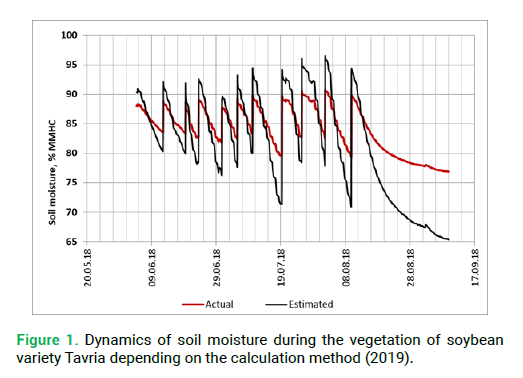
Figure 1: Dynamics of soil moisture during the vegetation of soybean variety Tavria depending on the calculation method ЕТс (2019).
The weighted average amount of productive precipitation over the years of research was at the level of 132 mm.
Calculation of evapotranspiration parameters showed that depending on the maturity group of soybeans, the evapotranspiration of ETc ranged from 588.1-677.7 mm, and ETc(FAO) from 535.3-627.2 mm.
Thus, the discrepancy between the calculations of ETs/ ETs (FAO), as a whole for the growing season of soybean varieties, was 7.5-9.0%, and in some phases of the growing season from 1.6-11.5% (Tab. 1).
| Date | Soybean–variety Oksana | Date | Soybean–variety Tavria | ||
| ЕТс | ЕТс (FAO) | ЕТс | ЕТс (FAO) | ||
| 01.05-08.06 | 133,6 | 144,1 | 01.05-08.06 | 141,9 | 144,1 |
| 09.06-3.07 | 277,4 | 265,9 | 09.06-02.08 | 359,8 | 318,3 |
| 24.07-23.08 | 117,1 | 125,3 | 03.08-12.09 | 176,0 | 164,8 |
| 01.05-23.08 | 528,1 | 535,3 | 01.05-12.09 | 677,7 | 627,2 |
Table 1. Evapotranspiration of soybeans of different maturity groups.
The average daily evapotranspiration of soybeans ranged from 1.3-6.3 mm in the initial phase of development, 3.5-7.9 mm the middle and 1.8-6.0 mm the final phase (Fig. 2.). The maximum parameters of the are important for making design decisions on the technical characteristics of the irrigation system. It is established that in the conditions of the Steppe of Ukraine the maximum daily evapotranspiration of plants (ETc_max) of medium-ripe soybean occurs in the II-III decade of July and is 7.2-8.0 mm. The same parameter (ETc_max) for late-maturing soybean varieties is 7.3-8.6 mm and was recorded during the third decade of July- first decade of August.
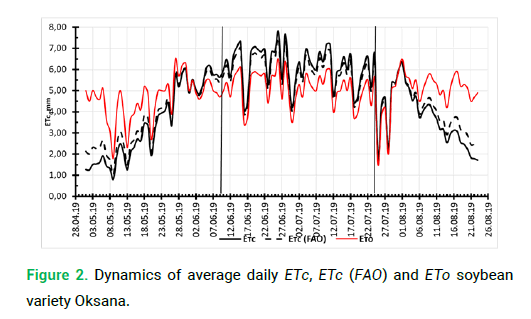
Figure 2: Dynamics of average daily ETc, ETc (FAO) and ETo soybean variety Oksana.
The ratio of ETc to ETc(FAO) according to formula (1), is characterized by the culture coefficient-Kc and Kc (FAO), respectively (Tab. 2.).
| Date | Soybean–variety Oksana | Date | Soybean–variety Tavria | ||
| Кс | Кс (FAO) | Кс | Кс (FAO) | ||
| 01.05-08.06 | 0,35-1,20 | 0,50-1,15 | 01.05-08.06 | 0,35-1,30 | 0,50-1,15 |
| 09.06-23.07 | 1,20 | 1,15 | 09.06-02.08 | 1,30 | 1,15 |
| 24.07-23.08 | 1,20-0,35 | 1,15-0,50 | 03.08-12.09 | 1,30-0,45 | 1,15-0,50 |
| 01.05-23.08 | 1,20 | 1,15 | 01.05-23.08 | 1,30 | 1,15 |
Table 2. Culture coefficients Kc and Kc (FAO) for soybeans of different maturity groups depending on the method of calculation of evapotranspiration of ETc.
Graphically, the dynamics of the ratio of Kc and Kc(FAO) during the growing season of soybean varieties of different ripeness groups is presented in Fig. 3 and Fig. 4. During the study period (2017, 2018, 2019) Kc, although different, but its relationship to Kc(FAO) is clearly correlated in time, which allowed, for further calculations of ETc by the method of “Penman-Monteith”, to take the average value Kc. The difference between Kc and Kc (FAO) by phases of development of soybean plants was: in the initial (“seedlings-the beginning of flowering”) phase-4.2-42.8%, the middle (“beginning of floweringpouring beans”)-4.2 -11.5% and the final (“filling beansfull ripeness”)-4.2-42.8%.
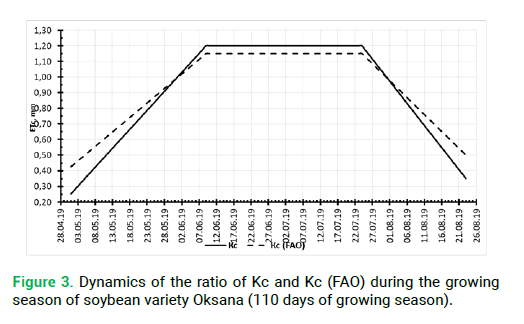
Figure 3: Dynamics of the ratio of Kc and Kc (FAO) during the growing season of soybean variety Oksana (110 days of growing season).
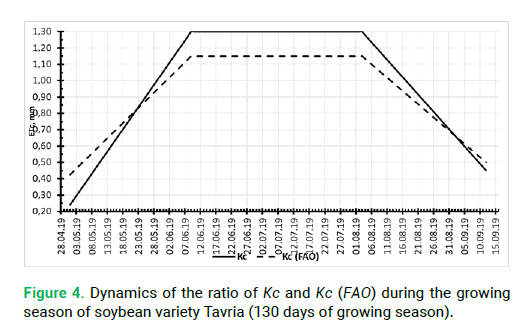
Figure 4: Dynamics of the ratio of Kc and Kc (FAO) during the growing season of soybean variety Tavria (130 days of growing season).
Conclusion
On the basis of experimental researches the estimation and substantiation of necessity of adaptation of the calculation method of definition of evapotranspiration ETc “Penman-Monteith” in the irrigated conditions of the Steppe zone of Ukraine on the soybean crop was carried out. The coefficients of culture Kc soybean crop for varieties of different ripeness groups have been calculated, taking into account the local climatic conditions of the Steppe zone. It was confirmed that the actual values are different from Kc (FAO): at the initial and final stages of development of soybean plants, Kc (FAO) overestimates the actual values of evapotranspiration to 42.8%, and in the middle phase, on the contrary, underestimates by 4.2-11.5%. Thus, the use of Kc (FAO) in the calculations of evapotranspiration ETc for standard conditions will lead to over-watering at the beginning and at the end of the growing season of soybeans and a deficiency of moisture reserves in the critical period of plant development (phase “beginning of flowering-poured beans”).
It is recommended in the future to determine the actual evapotranspiration ETc and operational control of the soybean irrigation regime on this basis to use the method “Penman-Monteith” taking into account the adjusted values of soybean culture coefficients Kc.The results of the presented studies can hypothetically be applied to soybean culture in other climatic zones as well, provided that during the growing season the average humidity in this zone is RHmin≈30%, and the average wind speed is v≈3 m/s.
References
Allen R.G., Pereira LS., Raes D., Smith M. 1998. Crop evapotranspiration-Guidelines for computing crop water requirements-FAO irrigation and drainage. Paper 56. Rome: FAO. http://www.fao.org/docrep/x0490e/x0490e00.htm
Allen R. 2000. Using the FAO-56 dual crop coefficient method over an irrigated region as part of an evapotranspiration intercomparison study. J Hydrol 229: 27-41. https://doi.org/10.1016/S0022-1694(99)00194-8
Annandale J., Stockle C. 1994. Fluctuation of crop evapotranspiration coefficients with weather: a sensitivity analysis. Irrigaton Sci 15: 1-7. https://link.springer.com/article/10.1007%2FBF00187789
Babych А.О., Babych-Poberezhna A.A. 2010. Soybean belt and placement of soybean production in Ukraine. Propozytsia 4: 52-54. https://scholar.google.com.ua/scholar?hl=ru&as_sdt=0,5&cluster=9572949490770541269
Campbell G.S., Campbell M.D. 1982. Irrigation scheduling using soil moisture measurements: theory and practice. Advances Irrigat 1: 25-42. https://doi.org/10.1016/B978-0-12-024301-3.50008-3
Jones H.G. 2004. Irrigation scheduling: advantages and pitfalls of plant-based methods. J Exp Botany 55: 2427-2436. https://doi.org/10.1093/jxb/erh213
Jones H.G. 2008. Irrigation scheduling-comparison of soil, plant and atmosphere monitoring approaches. Acta Horticulturae 792: 391-403. https://doi.org/10.17660/ActaHortic.2008.792.46
Jones H.G. 1990. Physiological aspects of the control of water status in horticultural crops. Hort Sci 25: 19-26. http://agris.fao.org/agris-search/search.do?recordID=US9019151
Pereira L., Allen R., Smith М., Raes D. 2015. Crop evapotranspiration estimation with FAO56: Past and future. Agricultural Water Management 147: 4-20. https://doi.org/10.1016/j.agwat.2014.07.031
Pereira L., Perrier A., Allen R., Alves I. 1999. Evapotranspiration: concepts and future trends. J Irrig Drain 125: 45-51. https://doi.org/10.1061/(ASCE)0733-9437(1999)125:2(45)
Rai R. (ed.) 2017. Planning and evaluation of irrigation projects: methods and implementation. Academic Press, London https://www.elsevier.com/books/planning-and-evaluation-of-irrigation-projects/rai/978-0-12-811748-4
Romashchenko M., Shatkowski A., Zhuravlev O. 2016. Features of application of the «Penman – Monteith» method for conditions of a drip irrigation of the Steppe of Ukraine (on example of grain corn). J Water Land Develop 31: 123-127. https://doi.org/10.1515/jwld-2016-0043
Rosner B. 2006. Fundamentals of biostatistics. 6th ed. Belmont, CA: Duxbury Press. https://www.worldcat.org/title/fundamentals-of-biostatistics/oclc/58918467
Ton Y, Kopyt M, Zachs I, Ben-Ner Z. 2004. Phytomonitoring technique for tuning irrigation of fruit trees. Acta Horticulturae 646: 127-132. https://doi.org/10.17660/ActaHortic.2004.646.15
Ushkarenko V.O., (ed.) 2014. Methodology of the field experiment (irrigated agriculture). Hrin D.S. Kherson: (In Ukrainian). https://scholar.google.com.ua/scholar?hl=ru&as_sdt=0,5&cluster=3820783351524686351
Wright J. 1982. New evapotranspiration crop coefficients. J Irrigation and Drainage Division 108: 57-74. https://eprints.nwisrl.ars.usda.gov/382/
Yemelyanov VA. 1983. Measuring soil moisture with irrigation methods. Hydrotechny and Land Reclamation 2: 56-60. https://scholar.google.com.ua/scholar?cluster=16935231113742047162&hl=ru&as_sdt=2005&sciodt=0,5