Research Article - Modern Phytomorphology ( 2025) Volume 19, Issue 6
Efficiency of strip-till technology for sugar beet production in the western forest-steppe
Dmytro Kyselov1*, Andrii Kyselov1 and Svitlana Kalenska22National University of Life and Environmental Sciences of Ukraine, Ministry of Education and Science, 15 Heroiv Oborony St., Kyiv, Ukraine
Dmytro Kyselov, Private Enterprise “Zakhidnyi Buh”, 39 Yunosti Avenue, Sheptytskyi District, Lviv Region, Ukraine, Email: dmytro.kyselov@zahbug.com.ua
Received: 11-Nov-2025, Manuscript No. mp-25-173704; Accepted: 11-Dec-2025, Pre QC No. mp-25-173704 (PQ); Editor assigned: 13-Nov-2025, Pre QC No. mp-25-173704 (PQ); Reviewed: 27-Nov-2025, QC No. mp-25-173704; Revised: 04-Dec-2025, Manuscript No. mp-25-173704 (R); Published: 18-Dec-2025 , DOI: 10.5281/zenodo.17976555
Abstract
Modern sugar beet cultivation requires technologies that ensure stable yields while reducing energy consumption and maintaining soil fertility. In the western forest-steppe of Ukraine, where periods of excessive moisture alternate with summer droughts, adapting primary tillage systems to climate variability is a critical challenge. The strip-tillage (strip-till) system represents one of the most promising practices of conservation agriculture, combining the efficiency of conventional tillage with environmental sustainability. The objective of this study was to investigate the effect of the strip-till technology on the yield, quality, and economic efficiency of sugar beet cultivation under the agro-climatic conditions of the western forest-steppe of Ukraine. In the comparative field experiment, two tillage systems were evaluated: Conventional non-inversion combined tillage (Horsch Tiger AS) and strip-tillage (strip-till). Indicators of yield, root quality, energy efficiency, and economic performance were assessed. Statistical analysis was performed using Analysis Of Variance (ANOVA) methods. Actual root yield under the strip-till system reached 96.03 t ha-1, which was 11.6 % higher than under conventional non-inversion tillage (84.39 t ha-1). The strip-till technology resulted in an 11.6 % increase in root yield, a 6.6% increase in total biomass, and an 8.0% rise in technological sugar yield compared with the conventional system. Additionally, juice purity increased by 0.09%, confirming an improvement in processing quality. The use of the strip-till system under the conditions of the western forest-steppe of Ukraine proved to be an effective tool for enhancing productivity, energy efficiency, and ecological stability in sugar beet production, meeting the principles of modern conservation agriculture.
Keywords
Strip-till, Sugar beet, Yield, Technological sugar, Energy efficiency, Profitability
Introduction
Sugar beet (Beta vulgaris L.) is one of the key industrial crops in the agriculture of Central and Eastern Europe, serving as the primary source of sucrose for the food, bioethanol, and processing industries (FAO, 2022). At present, conventional intensive tillage systems based on deep ploughing are increasingly questioned due to their high energy consumption, soil structure degradation, and declining profitability (Nowak and Wnuczek, 2023).
Classical deep ploughing, long applied to create a fine seedbed for sugar beet, is associated with significant energy losses and deterioration of the soil’s agrophysical properties (Grunwald and Koch, 2024). In response to these challenges, modern sustainable agriculture has shifted toward reduced and strip-till systems that combine ecological stability with economic feasibility (Laufer and Koch, 2017, Jaskulska and Jaskulski, 2020). The strip-tillage (strip-till) technology, which involves loosening narrow soil bands in the crop rows with localized fertilizer placement, is viewed as a compromise between conventional ploughing and no-till systems (Morris, et al. 2010).
Long-term studies conducted across Europe and North America demonstrate that strip-till substantially improves soil structural stability and reduces erosion risk, particularly on light-textured and sloping soils (Laufer and Koch, 2017). Under Central European conditions, strip-till was found to decrease surface runoff by 40%-60% and soil erosion by up to 70% compared with deep ploughing. Moreover, this system enhances organic matter accumulation, stimulates biological activity, and increases the proportion of stable aggregates (Bending, et al. 2002). In long-term experiments, soil organic carbon content was 12%-18% higher under strip-till than under ploughing (Al-Kaisi, et al. 2014). These results are crucial for restoring soil fertility and reducing CO2 emissions within the framework of European climate strategies (Saldukaite, et al. 2022, Bruciene, et al. 2024).
The effect of tillage system on sugar beet yield remains ambiguous and depends strongly on soil type, moisture, and weather conditions. According to Laufer and Koch, 2017, on loamy soils of Central Europe, yield reduction under strip-till did not exceed 2%-5% compared with conventional ploughing, and under adequate moisture conditions even resulted in yield gains. Jaskulska and Jaskulski, 2020 reported root yields of 69-74 t ha⻹ under strip-till compared with 70-75 t ha⻹ under traditional ploughing. At the same time, the technological sugar yield was often higher under strip-till due to reduced nitrogen losses and more stable moisture conditions in the 0-30 cm soil layer (Gaj, et al. 2015, Afshar, et al. 2019).
European studies (Górski, et al. 2022) have shown that sugar content (16.8%-17.5%), juice purity (90%-92%), and extractable sugar coefficient are maintained or even improved under strip-till compared with ploughing. Jahan, et al. 2025 demonstrated that an optimal loosening depth of 25-30 cm ensures uniform root development and facilitates mechanical harvesting without subsoil compaction. The objective of this study was to provide a scientific justification for the efficiency of strip-tillage technology in sugar beet cultivation under the conditions of the Western Forest-Steppe of Ukraine, considering its impact on yield, technological root quality, as well as the energetic and economic efficiency of production.
Materials and Methods
The study was conducted during the 2024-2025 growing seasons on the experimental fields of Private Enterprise “Zakhidnyi Buh” Stryi District, Lviv Region, located within the western forest-steppe zone of Ukraine. The area is characterized by a moderately continental climate, with an average annual precipitation of 650-700 mm and a mean temperature during the growing season of +16.5°C (Fig. 1). The prevailing soils are calcareous medium loamy chernozems, containing 3.2%-3.6% humus in the 0-30 cm layer, a slightly alkaline reaction (pH 7.2-7.5), and medium levels of available phosphorus (P2O5: 110-125 mg.kg-1) and potassium (K2O: 95-105 mg.kg-1).
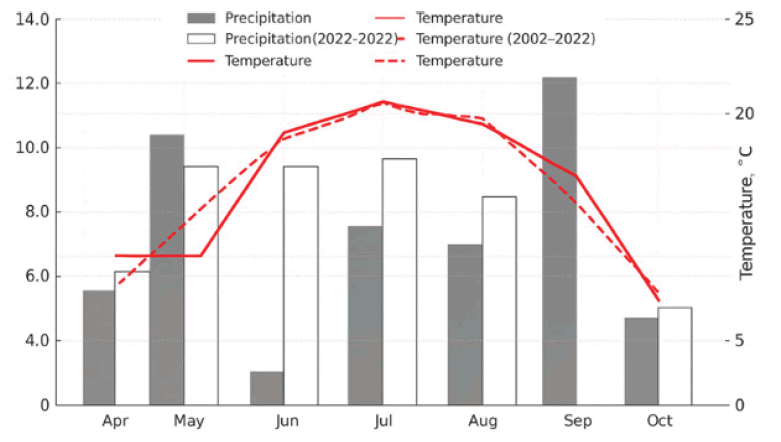
Figure 1: Weather conditions during the sugar beet growing season (April-October 2025) compared with long-term averages (2002-2022) recorded at the Chornyi Ostriv meteorological station.
The field experiment was established as a stationary design comparing different primary tillage systems for sugar beet. The total experimental area covered 40 ha-1, divided into accounting blocks of 2 hectares each, arranged in three replications. The study employed the sugar beet hybrid Strube Carroll.
Two soil tillage systems were compared: Conventional non-moldboard combined tillage (control)-implemented using a Horsch Tiger AS cultivator to a depth of 25-27 cm, followed by seedbed leveling and pre-sowing cultivation; strip-tillage (strip-till) performed using a strip-master EN 6000 unit (Bendar, Czech Republic), which provides deep localized loosening to a depth of 25-30 cm within 20 cm-wide strips, simultaneous banded fertilizer application, and seedbed formation for precision seeding. In the strip-till system, inter-row zones remained undisturbed, with retained soybean residues serving as mulch, providing erosion protection, improved soil aggregation, and reduced moisture loss.
Statistical data processing was performed using Analysis Of Variance (ANOVA), with the significance of differences determined according to the least significant difference test (LSD0.05). All calculations and graphical visualizations were conducted using Statistica 13.3 and Microsoft Excel 2021.
Results and Discussion
Field observations conducted in the Western Forest-Steppe of Ukraine (Lviv region) demonstrated that under the strip-till system (strip-master EN 6000, Bendar, Czech Republic), sugar beet crops developed uniform and well-aligned emergence, although slightly slower early growth dynamics were recorded compared with the conventional non-inversion tillage (Horsch Tiger AS). Emergence occurred simultaneously in both treatments on April 17, 2025, indicating that the strip-till system did not delay seed germination. However, at the 1-2 leaf-pair stage, plant density reached 99,000 plants.ha-1 under strip-till versus 103,000 plants. ha-1 under conventional tillage, suggesting slightly greater variability in microrelief and moisture distribution across the tilled strips.
During the subsequent growth phases, the strip-till system showed distinct advantages during hot and dry periods, maintaining better soil moisture, fewer stress symptoms, and more stable leaf turgor. The row-closure period was extended by 10-12 days in strip-till plots-occurring on July 1 (ΣT=1254°C) compared with June 20 (ΣT=1044°C) in conventional tillage-indicating a prolonged photosynthetic activity window.
The total biological yield (roots+tops) amounted to 148.3 t.ha-1 under combined tillage and 158.1 t.ha-1 under strip-till. Consequently, the root-to-shoot ratio increased by 6.7%, reflecting more efficient conversion of photosynthates into root biomass under strip-based soil management. This effect is attributed to higher soil heat capacity under mulch coverage and improved structural porosity resulting from localized deep loosening in the tilled strips.
The dynamics of root mass accumulation confirmed higher biological productivity of strip-till during the second half of the growing season. On 4.08.2025, the average root weight reached 721 g per plant under strip-till compared with 565 g in the control (Fig. 2), resulting in a biological yield increase of 3.45 t.ha-1 .
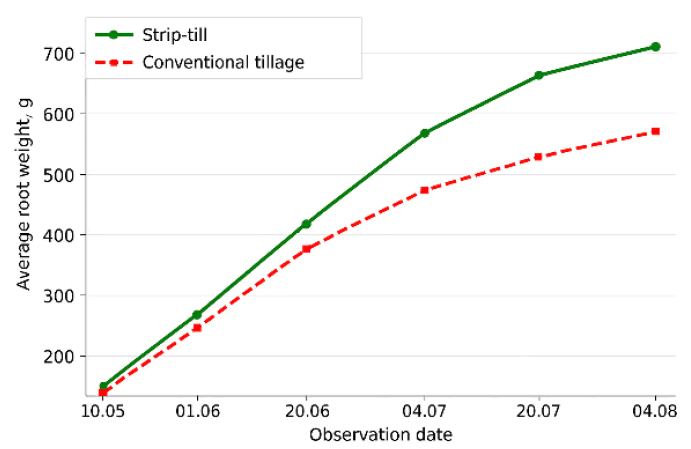
Figure 2: Dynamics of root weight accumulation under different soil tillage systems.
Actual root yield under the strip-till system reached 96.03 t ha-1 , which was 11.6% higher than under conventional non-inversion tillage (84.39 t.ha-1 ). Compared with the traditional system (Horsch Tiger AS), strip-till improved not only yield but also juice purity and technological sugar recovery (Tab. 1). A similar trend was observed by Laufer and Koch, 2017, who reported a 7%-10% yield increase and a 0.6%-1.2 % rise in technological sugar on loamy soils in central Europe.
| Soil tillage system | Root yield, t ha-1 | Sucrose content, % | Juice purity, % | Technological sugar, t ha-1 | Biological yield (root+tops), t ha-1 |
|---|---|---|---|---|---|
| Conventional noninversion tillage (Horsch Tiger AS) | 84.39 | 16.42 | 14.22 | 11.98 | 148.3 |
| Strip-till (strip-master EN 6000, Bendar) | 96.03 | 16.48 | 14.31 | 12.94 | 158.1 |
| Increase, % | +11.6 | +0.4 | +0.6 | +8.0 | +6.6 |
Table 1. Yield and technological quality of sugar beet under different soil tillage systems (2025).
Sucrose content was comparable between systems (16.48 % vs. 16.42 %), but juice purity was higher under strip-till (14.31 % vs. 14.22 %), indicating improved raw material quality. Although the difference in sucrose concentration was minimal, the higher purity and technological sugar coefficient under strip-till suggest a more favorable nutrient balance, particularly regarding nitrogen. Localized fertilizer placement during strip tillage ensures efficient root uptake and reduces losses through leaching and denitrification (Gaj, et al. 2015, Afshar, et al. 2019).
Calculated technological sugar output increased by 7.5%-8.2%, consistent with Górski, et al. 2022, who reported a 6.6%-8.2% improvement. A decrease in α-amino nitrogen content by 0.8 mg 100 g-1 was also observed under strip-till, aligning with Burba, 1996, who associated lower harmful nitrogen with targeted fertilization. The increase in juice purity by 0.09 % further confirms optimization of the nitrogen-to-potassium ratio, which is critical for technological sugar formation (Hoffmann and Märländer, 2001).
Conclusion
The conducted research demonstrated that the strip-tillage (strip-till) system in sugar beet cultivation under the conditions of the western forest-steppe of Ukraine is an effective and adaptive component of modern sustainable agriculture, combining high productivity, economic efficiency, and soil resource conservation. Implementation of the strip-till system (strip-master EN 6000, Bendar) with the Strube Carroll hybrid resulted in a more uniform crop structure and stable plant development throughout the growing season. Compared with the non-inversion combined tillage (Horsch Tiger AS), the strip-till system increased root yield by 11.6%, biological mass by 6.6%, and technological sugar yield by 8.0%.
The results confirmed that strip-till promotes efficient use of soil moisture and nutrients. Due to the preservation of a mulched surface layer and optimized hydrothermal conditions, soil moisture increased by 10%-12%, while soil temperature decreased by 1.8- 2.4°C during hot periods. These effects positively influenced photosynthetic activity and root mass accumulation, indicating an adaptive plant response to the region’s climatic conditions.
Overall, the obtained data confirm the practical value of implementing strip-till in sugar beet production systems across western Ukraine. The findings provide a scientific basis for developing integrated soil management technologies within the framework of conservation agriculture aimed at improving sustainability and resource efficiency in modern crop production.
References
- Afshar RK, Nilahyane A, Chen C, He H, Stevens B, Iversen WM. (2019). Impact of conservation tillage and nitrogen on sugar beet yield and quality. Soil Till Res. 191:216-223.
- Al-Kaisi MM, Douelle A, Kwaw-Mensah D. (2014). Soil microaggregate and macroaggregate decay over time and soil carbon change as influenced by different tillage systems. J Soil Water Conserv. 69:574-580.
- Bending GD, Turner MK, Jones JE. (2002). Interaction between crop residue and soil organic matter quality and the functional diversity of soil microbial communities. Soil Biol Biochem. 34:1073-1082.
- Bruciene I, Savickas D, Sarauskis E. (2024). Comparative environmental analysis of sugar beet production using a solar-driven robot and conventional systems from a sustainability perspective. Clean Environ Syst. 13:100186.
- Burba M. (1996). Harmful nitrogen as a criterion for beet quality. Sugar Industry. 121:165-173.
- FAO. (2022). FAOSTAT database. Food and agriculture organization of the United Nations.
- Gaj R, Budka A, Niewiadomska A, PrzybyÅ J, Mioduszewska N. (2015). Effect of different tillage methods on the nutritional status, yield and quality of sugar beets. J Elem. 20:571-584.
- Górski D, Gaj R, Ulatowska A, Miziniak W. (2022). Effect of strip-till and variety on yield and quality of sugar beet against conventional tillage. Agriculture. 12:166.
- Grunwald D, Koch HJ. (2024). Cover crop effects on fibrous roots and growth of subsequent sugar beet. Plant Soil. 495:487-498.
- Hoffmann C, Märländer B. (2001). Breeding progress for yield and quality in sugar beet. 64th Congress, Institut International de Recherches Betteravières, Bruges, Belgium.
- Jahan N, Solaiman AHM, Islam N, Choudhury S. (2025). Evaluation of morphological, yield and quality performance of sugar beet genotypes under different soil pH levels. Asian J Agric Hortic. 12:50-61.
- Jaskulska I, Jaskulski D. (2020). Strip-till one-pass technology in central and eastern Europe: A MZURI pro-til hybrid machine case study. Agron. 10:925.
- Laufer D, Koch HJ. (2017). Growth and yield formation of sugar beet (Beta vulgaris L.) under strip tillage compared to full width tillage on silt loam soil in central Europe. Eur J Agron. 82:182-189.
- Morris NL, Miller PCH, Orson JH, Froud-Williams RJ. (2010). The adoption of non-inversion tillage systems in the United Kingdom and the agronomic impact on soil, crops and the environment-A review. Soil Till Res. 108:1-5.
- Nowak A, Wnuczek R. (2023). Market determinants of sugar beet production profitability-a case study. Agron Sci. 78:43-53.