Research Article - Modern Phytomorphology ( 2026) Volume 20, Issue 3
Agroforestry systems as nature-based solutions for agroecosystem resilience and sustainable landscape restoration
Viktoriia Skliar1*, Ihor Kovalenko1, Andrii Butenko1, Maryna Sherstiuk2, Roman Yaroshchuk1, Hanna Klymenko1 and Svitlana Yaroshchuk12Department of Garden Design and Forestry, Sumy National Agrarian University, H. Kondratieva St., 160, Sumy, 40021, Ukraine
Viktoriia Skliar, Problem-Oriented Research Laboratory of Agroforestry and Agricultural Landscape Restoration, Sumy National Agrarian University, H. Kondratieva St., 160, Sumy, 40021, Ukraine, Email: skvig@ukr.net
Received: 25-May-2026, Manuscript No. mp-26-189687; Accepted: 22-Jul-2026, Pre QC No. mp-26-189687 (PQ); Editor assigned: 27-May-2026, Pre QC No. mp-26-189687 (PQ); Reviewed: 24-Jun-2026, QC No. mp-26-189687; Revised: 01-Jul-2026, Manuscript No. mp-26-189687 (R); Published: 27-Jul-2026 , DOI: 10.5281/zenodo.21805338
Abstract
This study evaluated the influence of field-protective agroforestry plantings on microclimatic parameters, population density, vitality structure, morphometric characteristics, and productivity of winter wheat (Triticum aestivum L.) agrocenoses in agricultural landscapes of Ukraine. Field observations, microclimatic measurements, morphometric analysis, vitality assessment, and productivity evaluation were conducted at different distances from shelterbelts and compared with open agricultural fields lacking agroforestry elements. The results demonstrated that agroforestry systems substantially modified environmental conditions by reducing temperature extremes, increasing relative air humidity, and promoting more stable snow cover distribution. The strongest ecological stabilization effect was observed within the 50-150 m zone from agroforestry plantings. Winter wheat populations on agroforestry-protected fields exhibited significantly higher plant density, improved morphometric development, and more favorable vitality structure compared with populations on open fields. Prosperous populations dominated within the 100-200 m zone from shelterbelts, whereas open fields were characterized mainly by depressive population types. Grain productivity on agroforestry-protected fields exceeded that of unprotected fields by 5.0-5.3 c ha-1. The obtained results confirm that agroforestry systems enhance agroecosystem stability through microclimatic regulation, improvement of crop vitality, and optimization of hydrothermal conditions. Agroforestry plantings should therefore be considered important components of sustainable agricultural management and post-war ecological restoration strategies in Ukraine
Keywords
Agroforestry systems, Shelterbelts, Agroecosystem resilience, Winter wheat, Microclimate regulation, Vitality structure, Biodiversity, Crop productivity, Nature-Based solutions, Sustainable landscape restoration
Introduction
Modern agricultural systems increasingly face the combined impacts of climate change, land degradation, biodiversity loss, and anthropogenic disturbances, including the consequences of military conflicts. Under such conditions, Agroforestry is increasingly recognized as one of the most effective nature-based approaches for enhancing the ecological resilience of agricultural landscapes and supporting sustainable land management.
Agroforestry systems integrate woody vegetation into agricultural environments and provide multiple ecosystem services, including microclimatic regulation, soil conservation, carbon sequestration, biodiversity support, and water retention. Recent studies have demonstrated that agroforestry systems substantially reduce wind velocity, improve soil moisture accumulation, regulate air temperature and humidity, and mitigate erosion and drought-related stress in agricultural ecosystems (Yzakanov, et al. 2024). Classical agroforestry studies also established that the ecological efficiency of field-protective agroforestry plantings depends on their spatial structure, permeability, and landscape configuration, which determine their capacity to regulate wind flow, snow accumulation, evapotranspiration, and soil moisture conservation.
The importance of agroforestry has become particularly evident in the context of war-related landscape degradation in Ukraine. Military activities cause severe disturbances of agricultural territories through destruction of vegetation cover, soil compaction, contamination, disruption of hydrological processes, and increased susceptibility to wind and water erosion. Recent assessments indicate that a substantial proportion of agroforestry plantings in eastern Ukraine have already been damaged or destroyed as a result of military actions, threatening the ecological stability of agricultural landscapes (Matsala, et al. 2024, Andreiev, et al. 2025).
In this context, agroforestry systems should be considered not only as agricultural management tools but also as key components of post-war ecological restoration strategies. Agroforestry interventions can contribute to soil recovery, reduction of deflation processes, restoration of ecological connectivity, enhancement of carbon sequestration, and improvement of local hydrothermal conditions necessary for agricultural recovery. Recent international policy-oriented assessments emphasize the strategic importance of agroforestry for the sustainable reconstruction of Ukraine and for strengthening climate resilience within the framework of European green deal objectives (Agroforestry in Ukraine, 2024).
Among the various agroforestry approaches, field-protective agroforestry plantings represent one of the most effective instruments for regulating environmental conditions within agroecosystems. Their influence extends beyond immediate tree stands and affects wind dynamics, snow retention, evapotranspiration intensity, soil water balance, and crop productivity across agricultural landscapes. Moreover, agroforestry systems are increasingly regarded as important nature-based solutions for restoring degraded and conflict-affected territories (RETURN, 2025).
Winter wheat (Triticum aestivum L.) remains one of the key cereal crops in Ukraine and plays a crucial role in ensuring food security and agricultural sustainability. Because this crop is highly sensitive to fluctuations in soil moisture, temperature, and overwintering conditions, it represents an effective model species for evaluating the ecological and agronomic effects of agroforestry systems.
Despite the extensive body of research devoted to agroforestry systems, limited attention has been paid to the integrated assessment of microclimatic regulation, population density, vitality structure, morphometric characteristics, and productivity of winter wheat under the influence of agroforestry plantings within agricultural landscapes of Ukraine. In addition, the ecological role of agroforestry systems in supporting the resilience and restoration potential of agroecosystems under conditions of increasing climate instability and war-related land degradation remains insufficiently investigated. The aim of this study was to evaluate the influence of agroforestry plantings on microclimatic parameters, population density, vitality structure, morphometric characteristics, and productivity of winter wheat agrocenoses, as well as to assess the broader ecological significance of agroforestry systems for enhancing landscape resilience.
Materials and Methods
The study was conducted within an agricultural enterprise where four experimental fields were selected: Two fields integrated with agroforestry plantings and two open fields without agroforestry systems. During the growing season, assessments were performed at different distances from agroforestry plantings (or from the field edge in open fields) in order to evaluate both microclimatic conditions and the structural characteristics of winter wheat agropopulations.
Microclimatic monitoring included measurements of air temperature, relative humidity, and snow cover height. Air temperature was measured using a standard meteorological thermometer, while relative humidity was determined using the psychrometric method. Snow cover depth was measured with a snow gauge according to generally accepted meteorological procedures.
Population density of winter wheat was assessed at distances of 5, 10, 25, 50, 100, 150, and 200 m from agroforestry plantings (or field edges). At each distance, 15-20 sampling plots of 1 m2 were established, and the number of plants within each plot was recorded. Mean population density values were calculated for the principal phenological stages of winter wheat development, including tillering, stem elongation, flowering, milk ripeness, and wax ripeness.
Morphometric analysis was conducted during the same developmental stages. The vitality structure of winter wheat populations was assessed using the vitality analysis approach developed by Zlobin, 2022. Plant phytomass was used as the key diagnostic trait for vitality classification. According to the vitality analysis framework, individual plants were assigned to one of three vitality classes: High (“a”), intermediate (“b”), or low (“c”). Population quality was quantified using the quality index: Q=1/2(a+b), where Q is the population quality index, a is the proportion of high-vitality individuals, and b is the proportion of intermediate-vitality individuals.
Based on the obtained Q values, populations were classified into three qualitative categories: Depressive populations (Q<0.1667); balanced populations (Q=0.1667-0.3333); prosperous populations (Q>0.3333). Statistical processing of morphometric data was performed using the software package. Vitality analysis was conducted using the software package VITAL, developed by Zlobin, 2022. At the final stage of the field experiment, winter wheat productivity was assessed at different distances from agroforestry plantings (or field edges) using the trial sheaf method. The obtained yield data were subsequently used to evaluate the ecological and agronomic efficiency of agroforestry systems.
Results and Discussion
The obtained results demonstrated the complex influence of shelterbelt systems on agroecosystem functioning and the condition of winter wheat populations. Shelterbelts were identified as important regulators of microclimatic conditions, directly affecting plant vitality, population density, and crop productivity. A conceptual model summarizing the effects of agroforestry systems on microclimate regulation, population vitality, and agroecosystem resilience is presented in Fig. 1.
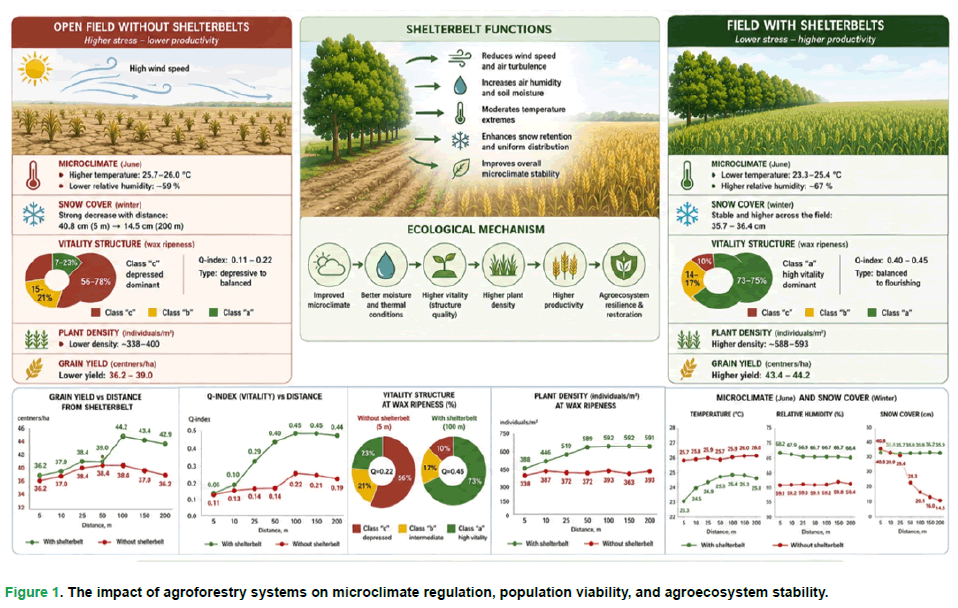
Figure 1: The impact of agroforestry systems on microclimate regulation, population viability, and agroecosystem stability.
Influence of agroforestry systems on environmental parameters
The assessment of air temperature and relative humidity dynamics demonstrated a pronounced microclimatic effect of agroforestry systems on adjacent agricultural fields. During clear summer days, air temperature within the 25-150 m zone from agroforestry plantings exceeded values recorded near the edge of agroforestry plantings and at distances greater than 200 m by 0.4-2.1°C. The strongest warming effect was observed at distances of 50-150 m.
This phenomenon is associated with reduced wind velocity within the protected zone, which prolongs air retention and enhances warming. Simultaneously, reduced air exchange contributed to higher relative humidity near agroforestry plantings. Average air humidity on protected fields remained consistently higher than on open fields lacking agroforestry elements.
In contrast, fields without agroforestry measures did not exhibit clear spatial patterns in temperature or humidity distribution. Air temperature remained uniformly elevated across the field, whereas relative humidity values were consistently lower than those observed in agroforestry-based agricultural landscapes. The combination of increased temperature and reduced humidity created less favorable conditions for crop growth and development. Winter observations further confirmed the ecological significance of agroforestry systems. Snow cover on protected fields was more evenly distributed, whereas open fields demonstrated substantial spatial variability. Enhanced snow accumulation under the influence of agroforestry plantings contributed to increased soil moisture reserves during spring vegetation renewal.
Effect of agroforestry measures on agropopulation density
Population density represents one of the key indicators of agroecosystem productivity and crop adaptation. The density of winter wheat populations varied substantially depending on the distance from agroforestry plantings.
Throughout the growing season, the lowest plant density was recorded at a distance of 5 m from the agroforestry strip (388-392 plants m2), whereas the highest density occurred within the 100-150 m zone (592-593 plants m2). Plant mortality during overwintering was particularly pronounced in the immediate vicinity of agroforestry plantings. Correlation analysis revealed a strong positive relationship between winter wheat survival and snow cover thickness r = +0.75. Since snow accumulation was directly influenced by agroforestry elements, these findings indicate the indirect role of agroforestry systems in enhancing winter crop persistence.
In fields without agroforestry measures, plant density ranged only between 338 and 400 plants m2 and lacked a clear spatial trend. Compared with agroforestry-protected fields, overall crop density was consistently lower, confirming the positive influence of agroforestry systems on crop establishment and survival (Agroforestry in Ukraine, 2024).
Influence of agroforestry systems on morphological structure of winter wheat
Morphometric analysis demonstrated substantial differences in winter wheat growth depending on the distance from agroforestry plantings. During the tillering phase, plants located 5-10 m from agroforestry belts exhibited the lowest values of aboveground biomass, plant height, and leaf number. In contrast, plants growing at distances of 50-150 m demonstrated the highest morphometric parameters, including greater biomass accumulation and leaf area development.
A clear gradient effect was identified: Most morphometric indicators increased with increasing distance from agroforestry plantings up to approximately 100 m and then stabilized toward the field center. Statistical analysis confirmed the significance of these differences, with all probability values below the accepted threshold p<0.05. On fields without agroforestry elements, no regular spatial trends in plant morphology were detected. Morphometric values remained significantly lower and statistically insignificant across all distances.
Similar tendencies persisted during the stem elongation phase. Maximum plant height, leaf number, and leaf area were recorded within the 100-200 m zone from agroforestry plantings. Correlation analysis indicated that morphometric development was strongly associated with local temperature and humidity conditions r=0.68, which were themselves regulated by agroforestry influence.
At the wax ripeness stage, plants on agroforestry-protected fields maintained substantially higher biomass, flag leaf area, spike mass, and grain number per spike compared with plants from open agricultural fields. All detected differences remained statistically significant. These results confirm that agroforestry systems positively affect both vegetative and generative development of winter wheat by creating more favorable hydrothermal conditions. Recent economic and ecological assessments likewise demonstrated that agroforestry systems considerably enhance crop productivity and landscape resilience in agricultural regions of Ukraine (Udawatta, et al. 2019, Openko et al., 2025). The identified morphometric differences were further reflected in the vitality structure and productivity of winter wheat populations.
Vitality structure and crop productivity under agroforestry influence
Vitality analysis revealed statistically significant differences in the quality structure of winter wheat populations depending on proximity to agroforestry plantings. On agroforestry-protected fields, populations located 5-10 m from tree plantings were dominated by low-vitality individuals (Class “c”), accounting for 80-90% of. However, beginning from 25 m and especially within the 50-200 m zone, the proportion of highly viable individuals (Class “a”) increased markedly.
At distances of 100-200 m, prosperous populations dominated, with 73-75% of plants belonging to the high-vitality class. Correspondingly, the population quality index increased progressively with distance from agroforestry plantings. In contrast, winter wheat populations on fields without agroforestry measures remained predominantly depressive or only moderately balanced. Low-vitality plants represented 56-78% of the population structure, indicating reduced adaptive capacity and lower production potential.
The identified differences in vitality structure ultimately affected grain productivity. The highest winter wheat yield was recorded at a distance of 100 m from agroforestry plantings, reaching 44.2 c ha-1, whereas the lowest yield occurred at 5 m (36.2 c ha-1). Fields integrated with agroforestry systems demonstrated an average yield increase of 5.0-5.3 c ha-1 compared with open agricultural areas. The obtained results demonstrate that agroforestry systems substantially enhance the productivity and ecological stability of agricultural landscapes through the optimization of microclimatic conditions, improvement of plant vitality, and stabilization of agroecosystem functioning. Beyond their direct effects on crop productivity, tree-based agricultural systems also contribute to long-term soil improvement processes (Pardon, et al. 2018).
According to the Food and Agriculture Organization, agroforestry represents one of the key approaches for climate adaptation, landscape restoration, and long-term recovery of degraded agricultural territories (FAO, 2023).
Conclusion
The present study demonstrated that agroforestry systems significantly improve the ecological functioning and productivity of winter wheat agroecosystems through the regulation of microclimatic conditions, including air temperature, relative humidity, and snow cover distribution. The strongest stabilization effect was observed within the 50-150 m zone from agroforestry plantings, where optimized hydrothermal conditions enhanced crop development and overwintering success. Agroforestry-protected fields showed higher plant density, improved vitality structure, greater morphometric development, and increased grain productivity compared with open agricultural fields. The highest productivity and vitality indices were recorded at distances of 100-200 m from shelterbelts, whereas plants located immediately near tree plantings exhibited reduced growth due to competitive interactions. Overall, agroforestry- integrated fields were characterized by more balanced and prosperous population structures and demonstrated an average yield increase of 5.0-5.3 c ha-1. In the context of climate instability and war-related land degradation in Ukraine, agroforestry systems should be considered effective nature-based solutions for sustainable land management and post-war landscape restoration.
Acknowledgement
Within the framework of the state budget research project “Agroforestry principles for the restoration of lands damaged by military actions”.
References
- Agroforestry in Ukraine. (2024). Seven reasons to invest in agroforestry for post-war reconstruction. Agroforestry network policy brief. Agroforestry in Ukraine 2024 policy brief.
- Andreiev A, Lysenko A, Golubov S, Stankevich S, Kozlova A, Artiushyn L. (2025). Geoinformation tool for remote assessment of shelterbelts damaged by military actions. Ukr J Remote Sens. 12:12-20.
[Crossref]
- FAO. (2023). The role of forests and agroforestry in climate-resilient agriculture. Food and Agriculture Organization of the United Nations.
- Matsala M, Odruzhenko A, Sydorenko S, Sydorenko S. (2024). War threatens 18% of protective plantations in eastern agroforestry region of Ukraine. For Ecol Manag. 578:122361.
- Openko I, Tykhenko R, Kuzmych L, Tykhenko O, Tsvyakh O, Rokochynskyi A, Halecki W. (2025). Economic modeling of shelterbelt land use on agricultural production in Ukraine. Land. 14:2236.
- Pardon P. (2018). Trees increase soil organic carbon and nutrient availability in temperate agroforestry systems. Agric Ecosyst Environ. 247:98-111.
- RETURN: Restoring environments in Ukraine. (2025). Analytical report on ecological restoration and nature-based solutions in post-war Ukraine. Return report on restoring environments in Ukraine.
- Udawatta RP, Rankoth L, Jose S. (2019). Agroforestry and biodiversity. Sustainability. 11:2879.
- Yzakanov T, Mamytkanov S, Ibraimova Z, Steinberg E, Alibakieva C. (2024). Study of agroforestry methods and techniques for soil erosion prevention on agricultural land. Ukr J For Wood Sci. 15:72-89.
- Zlobin YA, Skliar VG, Klymenko GO. (2022). Biology and ecology of phytopopulations. Sumy: Universsty Book. 512.